Monday, September 14, 2009

Burning Man 2009

My first Burning Man experience. After 10 years of wanting to go, I finally went this year with my husband. So glad I did. It was a wonderful experience.

Lots of preparation goes into Burning Man since you have to be 100% self-reliant - bring all your food, water, shelter, first-aide.We rented and drove this RV through the desert from El Monte RV - a burner friendly RV company - to Black Rock Desert in Nevada. Me and my baby. I drove it through the desert, the windy passes, and even up the narrow streets and hills up to my house afterwards and parked it right in front of my house. Something my husband thought would be impossible. So I did the impossible.Heading towards the entrance - excitement ramps up as we see other burners & we know we're close after driving for hours through the desert.We have arrived. The infamous fence around the perimeter we'd read so much about. Quite a feat considering how large the event is.Me driving the RV. A 1st for me & I loved it. So glad we took the scenic route.Uwe ringing the Playa Virgin bell & declaring himself a Citizen of Black Rock City.

Greeters at the gate meet individually with each and every person who arrives. Nice personal touch. Anyone whose first time it is at Burning Man is called a Playa Virgin and an initiation is in order.

We heard from other Playa Virgins that they were made to lay in Playa dust and make sand angels on their backs & stomachs. Our greeter was nice & just had us ring a bell and gave us big hugs (although he got so excited to meet virgins that he forgot to give us the printed schedule).

We felt welcome from the start.
We found a great spot on the corner to setup camp. Great vantage point to see all the lit up art cars as they drove by.

This was one of my fav's - a house. People were sitting inside drinking tea. Love the idea!
A lit up fish art car.

You could hear the art cars coming before you actually saw them. They were booming with music. I'd run to get my camera in anticipation of the next cool art car to appear before my eyes. Felt like Alice in Wonderland. So much fun! Thunderdome! Just like the movie Mad Max.

Yes, there was a tournament going on inside, but the human bodies swarming all over the outer metal dome was the most fascinating part.
Woman holding fire. Beautiful.The eternal flame they keep going for the burning of the Man on Saturday.
Someone loves their mom.
One person stands inside this spinning cylinder with thousands of led lights.

You can't help smiling when you see the grin on the face of the person inside.

One guy who experienced it asked, "Am I still alive?" Our first glimpse of the Man.Two Playa Virgins. A panoramic view of the Man. The Opulent Temple. This year it's the "temple of forgiveness" with four entrance halls, intricately carved wood, multiple floors and a central altar that opens to the sky.

It's hard to believe this also goes up in flames. They burn the temple on Sunday.
A true 3D interactive Rubics Cube, with 4 players.We knew we were getting close to our camp when we'd see this sign. Love it. Self-reliance is a big part of it, although the kindness of strangers is amazing out on the playa. People fed me and gave me drinks & good company. Uwe and I chillin' at our camp.

Our neighbor was a guy from Wisconsin fluent in German. We met all kinds of interesting people out on the playa. Got painted with friends I met at camp - Jeremy & Taylor.

Daytime wandering around was such a fun adventure. Everyday there was something new to discover.
Bronze sculpture in Center Camp.Another sculpture in Center Camp.

Having a chai latte in Center Camp was a little bit of home & felt like such a luxury. This experience makes you realize how much we take for granted in our daily lives.
Uwe's favorite interactive exhibit. The phantom you see is Uwe jumping to another colored circle. He said he could have done that for hours it was so much fun. Each time you step on a circle, it turns a different color.

It was fun to watch him be a kid again.
A couch swing. So comfy!
Uwe wearing his burner gear: head lamp, goggles, dust mask.Our camp was directly across from the Barbie Death Camp. Where else can you have a death camp and a wine bistro?A mirage in the middle of the desert - a Buddhist Temple.
Couldn't resist taking a photo with my pink, Chinese parasol.
Freshly squeezed OJ.

I met this fellow with the same tin camping cup, although his made mine look like a baby cup.
The Playa at night. The Man burning.
A crowd of 40,000 people all sat down in cooperation so that everyone could see the man burn. That blew my mind. Oh the possibilities!Even after the nuclear explosion that nearly melted my face, the man stood for a long time before finally succumbing to the fire.

Burning Man was an incredible, life changing experience. It was so much more than I expected. Everyone should experience it at least once in their life.

Sunday, June 21, 2009

President Obama's statement on Iran

"The Iranian government must understand that the world is watching. We mourn each and every innocent life that is lost. We call on the Iranian government to stop all violent and unjust actions against its own people. The universal rights to assembly and free speech must be respected, and the United States stands with all who seek to exercise those rights.

As I said in Cairo, suppressing ideas never succeeds in making them go away. The Iranian people will ultimately judge the actions of their own government. If the Iranian government seeks the respect of the international community, it must respect the dignity of its own people and govern through consent, not coercion.

Martin Luther King once said – “The arc of the moral universe is long, but it bends toward justice.” I believe that. The international community believes that. And right now, we are bearing witness to the Iranian peoples’ belief in that truth, and we will continue to bear witness."

Sunday, May 17, 2009

The Circus is in town!

Circus Vargas 2009
http://www.circusvargas.org

I haven't been to the Big Top in eons (Cirque du Soleil doesn't count - I'm talking a real circus), so I'm excited about taking my little one to see it today. They have a special interactive pre-show for the kids as well. Tickets are a bit pricey, but it depends on the section seats you purchase.

Saturday, May 16, 2009

Strawberry Festival in Oxnard, CA

The 26th Annual Strawberry Festival is happening this weekend - May 16 & 17 in Oxnard.

Strawberry Festival Info:
Strawberry Meadows of College Park
3250 South Rose Avenue
Oxnard, CA
1-888-288-9242
http://www.strawberry-fest.org/

I took my 4 year old daughter today and we had a great time. Kids 4 years old and under are free. Plus all of the rides and shows inside are free.

They do a great job catering to kids with a merry go round, a choo choo train, face painting, shows for kids (magician, clowns, music), and a scarier swinging boat ride for older kids. Bales of hay all around for sitting and enjoying strawberries.

Ticket Prices:
Adult admission = $12
Seniors (62+) = $8
Youths (5-12) = $5
Active military and dependents with ID = $8
Children 4 and under are FREE.

Upside:
Of course the strawberries! Including strawberry: beer, champagne, nachos, a build your own strawberry shortcake, etc.

Downside:
The long lines for everything. Last year they had 60,000 visitors and they're expecting even more this year. So expect long lines especially at the food booths. Some of the booths also sold out.

Tips:
  1. Although it was hot in LA, it was fairly chilly in Oxnard with the cloud cover. So bring a thin jacket or sweater.
  2. Take the 118 fwy. Do NOT take the 101 unless you love sitting in bumper to bumper traffic.
  3. Park on the outskirts and walk in. I made the mistake of parking in the parking lot. It took an hour to go less than a mile to finally park. Once you get stuck in the Que - it's impossible to get out. Don't make the same mistake!
  4. The website went down the morning of the festival - I guess too many ppl were accessing it - so make sure you get all the info you need the day before. Or you can call the toll free number I have above for the recorded information message.

Click here to see more photos of us.

Sunday, May 10, 2009

My Mother's Day Gift

U. got me this original print by @gapingvoid for Mother's Day. How true this statement is! As soon as we get it framed, we're going to hang it up so we can see it everyday.

The key is to find other lone wolves. =)

The Joy of Gardening

Here's my story of a novice gardener's 1st organic vegetable garden.

Living on a hillside, having a garden is difficult without terracing. However there's a small, flat area of land that I had in mind for years. So 6 years after purchasing our home, and with my daughter's 4th birthday fast approaching, I woke up one morning determined to give my 1st garden a try.Beginning Stage:
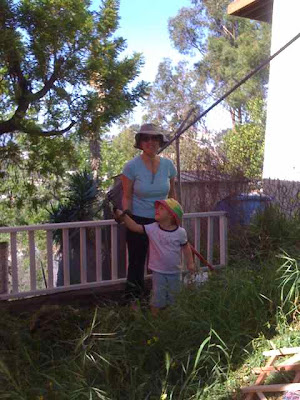
An out of control mound of weeds. Astrid was out there helping me pull weeds. It took a good 2 hours to clear all the weeds.

My mom has a green thumb and I grew up watching her create all sorts of gardens. But I had never tried to grow anything on my own, and more importantly never thought I would be good at it. So now as a mom myself, I felt it important that I at least try especially for Astrid's benefit, to see where food comes from.Vision:
An organic vegetable garden after a lot of sweat and muscle.

My sweet husband came out with some ice water and asked how we were doing. I told him he could help by pulling some weeds and gathering them up for the green garbage. He mentioned his hay fever and said he was in the house doing laundry and washing the dishes. We both burst out laughing at the irony of the women doing yard work and the man of the house staying indoors cleaning and washing.

If I had my choice, I'd be outdoors in my garden. And I was glad he was there with his camera to take some photos of us.After laying down 2 bags of organic fertilizer and planting the seeds - here is what the garden looked like. A month later:
My tranquil, organic vegetable garden. I love it and so does my daughter. I needn't worry about forgetting to water it because my daughter reminds me everyday that we need to water the garden - morning and night.

I wasn't sure if I'd have any luck with seeds, but everything came up eventually.Butter Lettuce. Carrots. Pumpkin. They're already growing like crazy and I have a feeling they will take over the garden. Hoping for a couple pumpkins in time for Halloween.Tomato plants. Onions. End product:
Freshly picked lettuce we made into a salad with organic tomatoes and a vinaigrette. Something very satisfying about eating veggies from your own garden. However, next time I don't think I'll be growing lettuce again. It takes a lot of water and as you can see after all that we had 1 serving of lettuce.

Next I would like to try Brussel sprouts and hardier veggies, now that I'm a bit more confident of my abilities and what my garden will grow.

It feels good to learn something new and try something that I've never tried before. While I'm watering my garden I have some quiet time to meditate each day. I need that tranquility and peace, which my garden gives me. Now I get why my mom was so into gardening. It took me awhile but I finally get it.

Saturday, May 09, 2009

"The Road" - In Movie Theaters October 16, 2009

"The Road" movie- based on the Pulitzer Prize-winner bestseller from acclaimed novelist Cormac McCarthy ("No Country For Old Men") is set to hit movie theaters this October. "The Road" is a dramatic thriller/sci-fi story about a father and his young son struggling to survive in a post-apocalyptic America. All they have is each other.
The book was my favorite of last year. The bond and love between father and his young son and the sci-fi description of a cruel/devastated world in the future, had such brilliant writing, I ended up finishing the book in one sitting & even convinced my husband to read the book. I've been looking forward to the movie ever since. If done right it should be a beautiful movie that will move you to tears and haunt you for weeks afterward. Previously I read that it ran into budget/financing problems and they didn't even think it would be released - but now it looks like it will be.

In the movie "The Road" the father is played by Oscar nominee Viggo Mortensen, and son by newcomer Kodi Smit-McPhee. Oscar winners Robert Duvall (who plays the Old Man) and Charlize Theron (who plays the wife appearing in flashbacks) make brief but "resonating appearances". The movie is done by The Weinstein Company (the same studio that did "No Country For Old Men").
Can't wait to see it on the big screen!

Saturday, March 28, 2009

My Very Own Organic Vegetable Garden

This is a pretty big deal for me. I've never been one with earth, or even a weekend gardener. I have a potted plant in my bathroom that I rescued from my office I used to work at, (they were going to throw it away because it was no longer "perfect") a fern of some sort that is still living 7 years later (with many near death experiences - I sometimes forget to water it until I see it's wilting).

People who have knowledge about such things and are good at it, mystify me. But I eat organic, and know that fresh produce is so much better - taste wise and also for the environment as it doesn't have been transported via plane, trains and/or automobiles. And then there's my fantasy which goes something like this - I need tomatoes for dinner, and instead of having to run to the grocery store, I just step outside and pick a ripe one off the vine. Being self sufficient and eating the fruits of my labor are great ideals. I like it. Where can I get it?

Oh that's right that means I have to go to Home Depot and pick up a bunch of gardening stuff like organic soil, tools, seeds, and gardening shoes. That's right - gardening while wearing green rubber shoes that even your kid says look funny. And then there's picking weeds for 2 hours in the hot sun.

I sure hope my first attempt at gardening actually grows some vegetables. I planted tomatoes, carrots, lettuce, pumpkin, and onions. Simple veggies for a first time gardener.

Astrid helped me pull weeds, even out the soil, and plant seeds. She was so gung ho about doing everything until I actually let her and each time it wasn't as much fun as she originally thought. "I'm tired. It's hard and there's too much!" Yep. I felt the same way. But it will be so much fun to watch everything grow and a great teaching tool for Astrid.

I'll be so proud if I can feed my family with this garden. Now I just have to remember to water it everyday.

Saturday, March 14, 2009

Mission Accomplished

@convagency (aka U.) & @gapingvoid (aka Hugh MacLeod)

U. is attending the South by Southwest (SXSW) 2009 media conference in Austin, Texas. My one request was that he meet @gapingvoid and get a photo with him.

And here he is doing a drawing for me.

U. told him his wife was a big fan, so he drew me a personalized SXSW drawing, but instead of drawing a guy giving the middle finger, he changed it around a bit for me, as you can see in the pic above. Sweet! He's such a character. Wish I could have been there.

U. said he will guard it with his life to bring it back to me.

Thursday, March 12, 2009

More of gapingvoid


"The internet made the world I aspired to belong to a lot easier to reach, no doubt about it. I think that's why so much of us spend so much time on the the internet. Suddenly the world we want to belong to seems a lot closer. It's hard to turn that newfound excitement off." - gapingvoid (aka Hugh MacLeod)

Tuesday, March 03, 2009

The Bachelor - Jason Mesnick on Jimmy Kimmel (What a schmuck!)


Jimmy Kimmel introduces the Bachelor Jason Mesnick as a "fickle pickle" and goes on to give him a hard time.

He asks him the question on my mind, "Why actually propose marriage? When you could have said - I pick you. Let's hang out."

What floors me is that Molly took him back and started making out with him in a nanosecond. I'm still shaking my head about it. But it did make good reality TV. This will go down in the Reality TV Hall of Fame, and EVERYONE is talking about it.

Jimmy asks the Bachelor, "Do you have the numbers of the other contestants in case you change your mind?" I love Jimmy Kimmel!

Saturday, February 28, 2009

A Day at the Nail Salon


This comedian talks about a day at the nail salon. Hilarious!

Great Depression Cooking with Clara


Clara Cannucciari a 93 year old grandmother in upstate New York has become the latest YouTube sensation after her grandson filmed her making meals that her family ate during the Great Depression.

In this video Clara cooks what she calls “the three-course Poorman’s Feast,” which includes salad and lentils, rice and a little bit of meat cooked in lemon and oil.

Part of her appeal is of course that in these times of financial troubles people are doing whatever they can to stretch their dollar. But I enjoy it because they're simple meals with simple ingredients that are easy to replicate. As an added bonus, while the food is cooking, Clara sits down on the couch and shares stories of her life during the depression. It's like spending time with your grandmother while she cooks. Something very endearing about that.

Thursday, February 26, 2009

We Need to Talk (Gapingvoid)

My husband turned me on to this guy who goes by Gapingvoid. He's a social marketing guru who draws these simple little cartoons on the back of business cards. He's a genius all around, and highly entertaining. I look forward to his tweets on Twitter more than anyone else (with the exception of my husband).

If you're interested, check out his work at: http://gapingvoid.com

Sunday, February 15, 2009

Depression survivors remember hope

By P.J. Huffstutter, First In A Series Of Occasional Stories About Economic Struggles In America February 15, 2009

The lessons they learned during childhood in the 1930s weren't easy, but have lasted a lifetime.


In the early hours before dawn, Thelma May Beets shuffled across the cold linoleum floor for a weekly inspection of the trunk next to her bed.Her husband built the rust-colored tool chest when he came home from World War II. Now it is full of food: sugar, pasta, soup, oats, crackers, creamer.

Nearly blind, she reviewed her inventory by touch -- peanut butter jars with ridged lids, ground coffee rustling inside a can like dried oak leaves blown in the wind."If you like to eat, you better save some," said the 91-year-old widow, her fingers spotted with age and curled by arthritis. Thelma has long kept some food in the chest, but as the latest recession has deepened, she's made a point of keeping it full.


It's a compulsion she learned as a child of the Great Depression, the period of epic hardship that began with the stock market crash in 1929 and lasted for a decade.Her memories of that time have come flooding back lately. The survivors of the Depression are approaching the ends of their lives, and their tales flow freely -- of countless injuries and precious joys. They experienced humiliation and unexpected generosity, moments of fear and times of laughter.


The privation left scars that have lasted a lifetime. Thelma still smarts from the looks that other children gave her worn checkered dress, her only one. The bare walls of the abandoned home her family moved into, and snowflakes that sneaked in through broken windows, still linger in her memory.

"My age group, the older people, we came up the hard way," she said from her home in Sedalia, Ind., about 60 miles northwest of Indianapolis.


But many survivors of the Great Depression say that their youth eventually became a time of triumph for them. The country, ever resilient, learned to adapt to this society of wanting and embraced a cooperative spirit that would carry it through another world war, the Cold War and a dozen recessions to come.

The children of those times learned things that they would remember for the rest of their lives. They discovered how to make endless pots of soup, how to use corncobs for fuel, how to make undergarments from bleached feed sacks. They learned the value of a wild imagination and honest neighbors.They were good lessons.

BERTHA GREENSTEIN
It all began for Bertha Greenstein when she couldn't get a new pair of shoes.Good shoes were everywhere in New York in the late 1920s -- T-straps, Mary Janes, slip-on boots, soft leather pumps. Nothing said style like shoes.

Her father, Jacob Greenstein, was an immigrant from Romania and co-owned a tailoring shop in Lower Manhattan. He spent his days surrounded by bolts of fine cashmere and the sharp, rich scent of hair tonic. His nimble fingers smoothed the cloth across the shoulders of stylish stockbrokers and other businessmen.

Bertha was not quite 11 when the stock market crashed in 1929. Still, she was old enough to navigate New York's streets alone. On weekends, she delivered her father's lunch and watched the customers pass through the glass double doors of Tress and Greenstein.In the weeks after the crash, she heard people on the street talking about wealthy men who had lost their fortunes. Some drank poison or hanged themselves, the newspaper hawkers bellowed on the streets. She became aware that her father, now pale and drawn, was spending more time at home.

"He never talked about the business to the kids or when we were present," said Bertha, the youngest of seven. "He would say, 'Well, we'll have to look for something else to do.' "Eight months after the crash, Jacob sold his share of the tailoring shop and bought a bakery on 110th Street, a block from Central Park. It was a deep and narrow storefront with a faded green awning. People lined up for dense loaves of rye and horn-shaped rolls covered in salt.

Every couple of weeks, as customers' debts grew, her father sent her to collect. She would crisscross the neighborhood, climb flights of stairs and politely ask for the lady of the house. Everyone recognized her as the baker's daughter.

She loved to walk -- to school, to basketball games, on dates strolling through Central Park. She found jobs along the way -- tutoring children, selling paper flowers, folding bolts of cloth in a fabric store.There was a beauty to never standing still, even though it was hard on her shoes.

When holes in her soles grew to the size of quarters, she cut off a chunk of the tan cake boxes in her father's bakery and slipped them inside her shoes, over and over again."If the cardboard was thin, we'd put two layers in," said Bertha, 90, who still arches her tiny feet when she walks on a cold day, as if trying to get away from the memory of wet snow.

LEMUEL ARTHUR LEWIE JR.
It took time for the Depression to settle into the minds of children whose parents had jobs, a precious commodity at a time when the national unemployment rate would eventually hit 25%.

Arthur Lewie's father, Dr. Lemuel Lewie Sr., was the only African American dentist on Main Street in Columbia, S.C. For years, patients -- black and white -- came to him with aching jaws and throbbing teeth.Arthur began to notice that things were different when patients stopped paying cash.

"They'd bring hams, chickens, things like that, for us," he said.Arthur was 10 at the time, the eldest of three, and he had never known hard times. Unlike many of their neighbors, the Lewies owned their wood-frame home, with a wraparound porch so wide that the children could race their tricycles on it. It sat on 4 acres of rich soil with corn, flowers and grapevines running along the side of the house.

His mother, Ophelia, heard the news of banks collapsing in the North. She suggested to her husband that they pull their money out of the black-owned bank in Columbia and invest in postal bonds. "My father left all his money in the bank and, of course, he lost it all," Arthur said.

He realized that life was changing. Trips to buy clothes became less frequent. There were fewer visits to family in other parts of the South.He began spending more time with his parents, turning the land into a working farm. Sections of lawn were replaced with rows of tomato plants, cabbage and collard greens. Pits were dug into the ground to store potato slips and vegetable seeds.

His father, who had a passion for automobiles, worked on his own car to save money. He showed Arthur how to fit piston rings, adjust valves and replace crankshaft bearings.Each vegetable picked and engine repaired impressed the boy with the importance of self-reliance.

"I knew the value of being able to make things, and do things yourself," said Arthur, 89. "I could be self-sufficient. . . . I could live off the land."I wouldn't ever have to beg," he said.

REVA GOODWIN
Reva Goodwin remembers lots of strangers showing up on her family's back doorstep, asking for something to eat. There was always a bowl of soup waiting for them.

In northwest Baltimore, she grew up with the constant smell of stock simmering from the blackened cast-iron pot that sat on the stove's back burner.Her mother, Edith, would add whatever was available to the pot, depending on the season and the amount of money that Reva's father, William, made from the auto repair shop he owned.

Bunches of kale, winter squash and ruby-red stewed tomatoes went into the pot. In the summer, ears of corn were shelled to join onions, potatoes, rice and celery.Meat joined the soup whenever available: ham hocks, chicken chunks, stew beef, bacon grease -- anything to make each spoonful more satisfying.

Visiting friends would cross the kitchen's gunmetal gray linoleum, carrying a gift for the pot. A couple that worked for a caterer in the city routinely arrived with boxes of leftover chickens, extra beans, even sweet rolls to enjoy after a bowl of Edith's soup.

That pot was never empty, and nothing in the kitchen was wasted. Ketchup bottles were turned upside down to coax the last few drops.My mother "had everything imaginable in that soup, all of the vegetables that were nourishing," said Reva, the eldest daughter of six children. There was always something to share.

Her father complained that she was giving away food, but Edith shrugged it off. Theirs was a tight-knit African American neighborhood, a line of brick row houses filled with schoolteachers, chauffeurs and city workers.As children grew older, winter jackets and summer dresses were passed down from home to home, until the cloth was too thin to wear. After that, they became rags for quilts and washing.

The people asking for food were often white. It didn't matter to Edith. In her eyes, having food to share meant the difference between being rich and barely surviving."In the neighborhood, everyone looked out for each other," said Reva, 79.

"We had to mind everybody in the neighborhood. . . . People have forgotten that."

RICHARD HARDING
Even with the help of family and friends, there were sacrifices, many of them beyond the understanding of children.

In the depths of the Depression in 1933, Richard Harding's mother found a job as a nurse's aide at Whidden Memorial Hospital, just outside Boston. The pay was decent and there was a spare room in the hospital's nursing home where she could live for free. There was, however, no room for children.

Richard was 7. His father, a fisherman from Newfoundland, had drowned when he was 10 months old. His mother, Temperance Anne, had struggled to raise him and his sister, Margaret.

Anne asked two of her brothers to take care of her children, and they agreed. Earlier in the Depression, she had helped them.

"I have to work and I'm sorry," Richard remembered his mother telling him.His uncle reminded him that he was "the extra kid in the family," said Richard, who resented the chores he had to do that his four younger cousins didn't have to.

Across town, Margaret was included in most family activities, but knew she too was a burden.Both uncles were carpenters who were struggling to find work in Boston. They rose early each morning and headed to a nearby union office, waiting for jobs that came sporadically.

Anne and the children spent weekends together. They wandered along the downtown square's shops, gazing at window displays of the latest fashions. "We never talked much about how we felt about how we were doing," Richard said.

For nearly four years, they lived apart from their mother. Richard thought of running away. Margaret grew withdrawn.Then Anne met Andrew Hillier, a Newfoundlander 12 years her senior. He was a good man with a steady job, and they wed in 1937. Anne told her children years later that she remarried to bring them home.

Long after the Depression, Richard said, his uncle reached out and they slowly developed a friendship. Richard, after raising his own family and facing his own worries, came to understand his uncle's words."A lot of his abrasiveness was this constant on edge of 'How am I going to provide for this family?' " said Richard, 82. "He gave me a roof to live under and enabled my mother to work."That was worth forgiveness, he figured.

JUDY KYSER
After years of the Depression, the hardships gradually began to ease as federal spending boomed, factory jobs grew and prices slowly rose.The changes, however, were hard to notice on the farm outside Jonesville, Mich., where Judy Kyser grew up.

She was an avid reader, sneaking away from the battered metal washtub to curl up on her feather bed with a stack of movie magazines about faraway Hollywood. At dusk, when the wagonload of hay had been harvested, she sat next to the family's oil lamp with murder mysteries and dreamed of solving crimes.

But as the Depression wore on, she set aside the books and magazines from the school library once the sun set. Coal oil was too expensive to waste.She was left to her own imagination at night.

"I can remember as a teen going to bed early because then I could dream," said Judy, now 84. "I dreamed about the movie stars and the different lives and how it would be to meet these people."

In 1936, President Franklin D. Roosevelt signed the Rural Electrification Act, which promised to install electrical distribution systems to rural areas. It was one of many government efforts to pump cash and technology into the country.

It took two more years for electricians to arrive at Judy's family farm. On a summer day, they came with rolls of cabling the size of a tractor and began planting wooden poles along the road.

Judy was the youngest of seven and the only girl. Her father had passed away. Her mother and two brothers were running the farm. Crop sales were rising. So was the price of milk.

That first night, after the workmen left, she raced to her bedroom. There it was: a light fixture, with a single bulb. She tugged on its metal chain and a warm light bathed the room.Within months, the family bought an electric iron, a washing machine and a radio. "It was all the things that made life easier," she said.

World War II was coming, and the country's impending burst of production would eventually catapult the U.S. out of its economic malaise.But at that first moment, a lightbulb was enough for Judy. The dark days of her childhood would never seem so dark again.

WHO THEY ARE
*Judy Kyser briefly attended Michigan State College and, under the stage name Judy Perkins, became a country music performer, starring in the "Midwestern Hayride" television show in the 1940s. She married Robert Sinclair in 1949 and had one child. Her husband died in 1965. The 84-year-old lives in Springdale, Ohio, a suburb of Cincinnati.

*Bertha Greenstein met David Gold, at a dance when she was 17. He courted her over the counter of her father's bakery and they married in 1941. She played on the Manhattan Co-Eds exhibition basketball team in the late 1930s and later worked as a secretary. The couple traveled the world, pursuing their hobby of learning new dances. David died last spring. Bertha, 90, lives with her eldest daughter and son-in-law in Watsonville, Calif.

*Arthur Lewie, 89, served as a first lieutenant with the Tuskegee Airmen during World War II. After the war, he earned a master's degree in biology from Atlanta University and taught science and math at George Washington Carver Vocational-Technical High School in Baltimore. He met Reva Goodwin at a funeral and they married in 1948; she is now 79. They live in the Baltimore suburb of Windsor Mill, Md., and have kept a vegetable garden at home for 50 years.

*Richard Harding, 82, served in the Navy in World War II, graduated from seminary, married in 1948 and had four children and seven grandchildren. A Methodist minister, he served as pastor of the historic Old West Church in Boston. Harding, now a part-time minister in Sudbury, Mass., established a group of retired United Methodist Church pastors in New England who perform same-sex marriage ceremonies. He and his wife, Shirley, live in Concord, Mass.

*Thelma May Young graduated from high school and married Paul Beets in 1936. The mother of six became a prolific writer of historical short stories and, until her eyesight began to fail, and was one of the most successful Tupperware salespeople in Indiana. She lives in the same house in Sedalia where she raised her children.

p.j.huffstutter@latimes.com

Thursday, February 12, 2009

Reunited 40 Years Later


Boston Globe
Maria Cramer
February 12, 2009

In 1968, a white firefighter saved a black baby girl, touching the heart of a divided city. The two did not meet again. Until yesterday.

The firefighter crawled on his stomach through the pitch-black apartment, the smoke so thick he couldn't see his hand in front of his face. Somewhere inside was a baby and he had to find her.

A window broke, light filled the room, and he saw her lying in her crib, dressed only in a diaper, unconscious. Soot covered her tiny nose. She wasn't breathing and had no pulse.

He grabbed her and breathed life into her as he ran from the apartment.

A newspaper photograph captured their image - a white firefighter from South Boston with his lips pressed to the mouth of a black baby from the Roxbury public housing development - at a time when riots sparked by racial tensions were burning down American cities.

But despite this most intimate of introductions, they remained strangers. William Carroll won a commendation for the rescue, stayed on the job another 34 years, and retired. Evangeline Harper grew up, lost her family to drugs and illness, had six children of her own, and became a nursing and teaching assistant. And through it all someone would often tell her the story about the day she almost died and the man who would not let it happen. She always wanted to meet him and say thank you.

Yesterday, more than 40 years after the fire, she finally did.

In the neighborhood where they first met, Carroll, a slim 71-year-old, got out of his car, dressed in a navy blue uniform he had borrowed from a fellow firefighter, strode up to the 40-year-old woman, and beamed.

"You've grown a lot since the last time I saw you," he said, laughing and putting out his hand. She smiled, gently took his hand, and looked at him almost shyly.

"Thank you so much for remembering me," he told her.

Then he pulled her into a tight embrace and they held on to each other as they stood on Keegan Street, just a few yards from where he had carried her limp body decades ago.

"Thank you so much," she said softly.

The Globe arranged the meeting after Evangeline Harper, now Evangeline Anderson, introduced herself to a reporter at a community meeting and asked for help tracking down Carroll.

Anderson, who now lives in Dorchester, had tried twice before to locate the firefighter, first when she was 18, after her adoptive mother told her about the rescue, and again right after the Sept. 11, 2001, attacks.

She tried to get his address from the Fire Department, but they said they could not give out personal information. She left her name and phone number, but never heard back.

"I thought, 'Oh, forget it. He probably doesn't remember," she said. " 'He's not interested.'

That could not have been further from the truth.

"Evangeline Harper," Carroll said. "I'll never forget her name if I live to be 100 years old."
He heard once that she had been trying to get in touch with him, but somehow her phone number was lost and he did not know how to reach her.

For a while, Anderson stopped looking. Then, she heard the news about Lieutenant Kevin M. Kelley, the firefighter who was killed in January after his firetruck crashed into a Mission Hill building.

" 'Oh my God, this could have been this gentleman, and I never got a chance to say thank you,' " she recalled thinking. "I didn't want him to leave this earth or I to leave this earth without saying thank you."

Yesterday, she brought her youngest child, 6-year-old Reginald, and her godmother, Jacqueline Greer, who witnessed the rescue. For the meeting, Anderson swept her hair in a curly updo and carefully applied lip gloss.

The women brought Carroll a giant stuffed bear, and a thank-you card tucked inside an envelope addressed "To Our Hero."

Richard Paris, vice president of the firefighters union, stood nearby with Carroll's wife and little Reginald, who kicked at the frozen snow on the sidewalk as Greer, Carroll, and Anderson reminisced about the neighborhood. Gone were the brick high-rises that had once formed Orchard Park. In their place were two-level attached apartments painted in pastels and browns.

"I haven't been here in so long," Carroll said.

No one could remember exactly what started the fire on Nov. 7, 1968, but Greer said it began in the family's kitchen. Carroll, who was assigned to Engine 3, heard the report of children trapped in a burning building.

When Carroll arrived, Greer was at the scene, screaming and crying hysterically.
Carroll saved Evangeline, while Firefighter Charles Connolly rescued her 17-month-old brother, Gerry, and handed him to Lieutenant Joseph O'Donnell, who gave the boy mouth-to-mouth resuscitation.

"He just cared," Greer, now 60, said of Carroll. "It wasn't that the child was black or she was white. It was a child and he was trying his best to bring her back her life."

Yesterday, both remembered who was missing from the reunion. Connolly and O'Donnell died long ago of heart problems. Anderson's brother Gerry succumbed to pneumonia as a toddler. Her grief-stricken mother turned to drugs for comfort, and died of an overdose at age 25. Her two sisters died young of natural causes. Last year, Anderson lost both her adoptive mother and uncle.

"I wish my friends . . . were here," Carroll said. "But they're up there watching over us."

"That's what I say about my family," Anderson said.

The two quickly built a rapport. He asked about her children, and she told him her eldest son was studying forensic science in college and how musical her other children are.

He told her he wanted to get to know her, and she promised to cook him some soul food.
"Oh, baby," he said, laughing. "I love it, but my stomach don't."

Carroll then took the group for lunch at Florian Hall, the union's headquarters, where Carroll still goes every week for coffee with friends or to help fellow retirees with healthcare questions. Over sandwiches, the group looked at old black-and-white photos of that day and traded stories about the challenges of raising children.

Carroll bonded with Anderson's son, who drew a picture of himself holding Carroll's hand.
Parting in the parking lot, Carroll hugged Greer and Anderson and told Reginald to call him.
"There's your new grandpa," Anderson said to her son.

"What a beautiful day," the retired firefighter said as he turned and walked back inside.

Wednesday, February 11, 2009

College student is excited and overjoyed to ask Obama a question


A college student in Florida gets chosen to ask the last question at a town hall meeting with President Barack Obama. (Obama went boy/girl/boy/girl so that no one would get mad at him. Hehe.)

This really touched me & made me smile. I feel the same way about Obama and his new administration being in the White House. Someone is really listening and trying to do some good. It's about time!

Sunday, February 08, 2009

56-year-old becomes first woman to swim Atlantic

Update: The great Atlantic Ocean swimming hoax

By Danica Coto, The Associated Press

SAN JUAN, Puerto Rico – Jennifer Figge pressed her toes into the Caribbean sand, exhilarated and exhausted as she touched land this week for the first time in almost a month.

Reaching a beach in Trinidad, she became the first woman on record to swim across the Atlantic Ocean — a dream she’d had since the early 1960s, when a stormy trans-Atlantic flight got her thinking she could don a life vest and swim the rest of the way if needed.


The 56-year-old left the Cape Verde Islands off Africa’s western coast on Jan. 12, swimming about 2,100 miles (3,380 kilometers) through strong winds and waves of up to 30 feet (9 meters).


She now plans to swim from Trinidad to the British Virgin Islands, ending her odyssey at the Bitter End Yacht Club in late February.


Then it’s home to Aspen, Colorado — where she trained for months in an outdoor pool amid snowy blizzards — to reunite with her Alaskan Malamute.

“My dog doesn’t know where I am,” she told The Associated Press on Saturday by phone. “It’s time for me to get back home to Hank.”


The dog swirled in her thoughts, as did family and friends, as Figge stroked through the chilly Atlantic waters escorted by a sailboat. She saw a pod of pilot whales, several turtles, dozens of dolphins, plenty of Portuguese man-of-war — but no sharks.


“I was never scared,” Figge said. “Looking back, I wouldn’t have it any other way. I can always swim in a pool.”

Her journey comes a decade after French swimmer Benoit Lecomte made the first known solo trans-Atlantic swim, covering nearly 4,000 miles (6,400 kilometers) from Massachusetts to France in 73 days. No woman on record has made the crossing.

Figge woke most days around 7 a.m., eating pasta and baked potatoes while she and the crew assessed the weather. Her longest stint in the water was about eight hours, and her shortest was 21 minutes. Crew members would throw bottles of energy drinks as she swam; if the seas were too rough, divers would deliver them in person. At night she ate meat, fish and peanut butter, replenishing the estimated 8,000 calories she burned a day.

Figge wore a red cap and wet suit, with her only good-luck charm underneath: an old, red shirt to guard against chafing, signed by friends, relatives and her father, who recently died.
The other cherished possession she kept onboard was a picture of Gertrude Ederle, an American who became the first woman to swim across the English Channel.

“We have a few things in common,” Figge said. “She wore a red hat and she was of German descent. We both talk to the sea, and neither one of us wanted to get out.”

Figge arrived on Trinidad’s Chacachacare Island, an abandoned leper colony, on Feb. 5 at 5:20 p.m. She plans to leave Trinidad on Monday night. During this brief respite, she has avoided the hotel pool and nearby ocean, opting instead for the treadmill.

Barack Obama is now following me on Twitter

From: Twitter twitter-follow-rmhook=yahoo.com@postmaster.twitter.com
To: rmhook@yahoo.com
Sent: Sunday, February 8, 2009 12:31:49 PM

Subject: Barack Obama is now following you on Twitter!

Hi, rosehook (rosehook).Barack Obama (BarackObama) is now following your updates on Twitter.

Check out Barack Obama's profile here: http://twitter.com/BarackObamaBest,Twitter

Saturday, February 07, 2009

Amazing Rainbow appears after the rain

My husband and daughter woke me up at 7:30 AM to view this beautiful rainbow (actually double rainbow if you look closely), that we could see from our home, after two days of rain. What a great way to greet the day!