"It is not just about the desire of the living to resuscitate the dead but about the ways in which the dead drag us along into their shadowy realm because we cannot let them go. So we follow them into the Underworld, descending, descending, until one day we turn and make our way back."
An excerpt appears in The New Yorker Magazine
Story's End - Writing a Mother's Death
by Meaghan O'Rourke
Damn that's good writing. I couldn't have said it better myself. A woman writes about her mother's death from Cancer.
Reading this brought me back to the days of driving my dad to doctor's appointments, when he was diagnosed with Bladder Cancer, radiation treatments, chemo, days spent in the hospital by his bedside...all of those memories came bubbling up to the surface.
It all happened so fast. He was dead a year after being diagnosed with Cancer. I'm still digesting and going over every detail in my mind, as if I could have averted what happened in the end - my dad dying.
There are days I am driving home and I get this pang in my chest that reminds me that I haven't seen my dad in awhile and that I should go see him. Pay him a visit. It happens all in a split nanosecond. That's when it hits me that I can't see my dad because he's dead.
It's been 8 months since my dad died. I still find myself in tears just about everyday at random moments of the day. There are times when I feel like he's with me. Times I'm driving by myself with the radio on and I swear it feels like he's sitting next to me in the passenger seat (just like all those times I drove him out to the VA Hospital). Or the time I was teaching my 5 year old daughter how to ride a bike. I felt his presence with us and was so sad he couldn't be there alive to see it. My daughter was in tears when she rode by me and said, "I miss Grandpa. I wish he didn't die." She felt it too.
That metaphor of following the dead into the Underworld and descending and descending is so dead on. My loved one died. He was my father. The first hurt was when his mind was going, the second when his physical body died. It's unthinkable to let him go. I'm the keeper of his memories. The last one who can prove he existed and tell you how much he meant to me. I can't abandon him. So I keep following him, while looking back the way I came. How much further before I have to turn back?
And the pain continues.
I miss my dad's voice, I miss him saying my name and his laughter and his jokes, and his warm, bear hugs. I even miss the feel of the stubble on his cheeks. I miss that he's not here to see his granddaughter grow (something that made him happy - He loved being a Grandpa). I read a blog post from a number of years back when my dad told me that he hoped he would live long enough for my daughter (his granddaughter) to remember him. And I know he hung on for as long as he did for us kids (my brother & I).
I'll follow you for as long as I can Dad, yet I know at some point I'll have to turn and make my way back. It doesn't mean I love you any less. And it will pain me to do so. The one comfort I have is knowing I will see you again when it's my time. We will hold hands like we always did and I'll have no reason to be afraid.
Monday, March 21, 2011


Thursday, March 17, 2011
1776-1976 U.S. "BiCentennial" Quarter

I've been finding a lot of 1976 bicentennial quarters lately. I hadn't seen one in years and now less than a year after my dad's death I've come across several of them. And each one holds a memory of my dad.
"Hold onto those. One day they'll be worth a lot of money," my dad would tell me when I was a kid. So I did. Every single one I came across I wouldn't spend it. I'd save it and put it with my collection.
(Coin collecting was a hobby we both enjoyed and would sit for hours with a magnifying glass sorting through coins together, filling up our blue books.)
So now as a 37 year old woman, my dad dead and buried, in less than a week I've come across 3 of these rare quarters that I hadn't seen in ages - and each time I thought of my dad and tears came to my eyes. I stored them away. Just like the memories of him that I keep close to my heart.
It's been 8 months since my dad died and I'm still heartbroken. I miss him. Little signs that trigger memories of him make me happy & hurt so bad. I still find myself with tears streaming down my face thinking about my dad.
I see this quarter. I smile. I think of my dad. I cry because I miss him. And I continue to cry because it's such a big loss. In more ways than I could ever imagine when he was living. And I cry even harder because I still love him very much as my life continues without him.
I love you dad. And those 1976 quarters will always remind me of you. Thank you for that memory.
"Hold onto those. One day they'll be worth a lot of money," my dad would tell me when I was a kid. So I did. Every single one I came across I wouldn't spend it. I'd save it and put it with my collection.
(Coin collecting was a hobby we both enjoyed and would sit for hours with a magnifying glass sorting through coins together, filling up our blue books.)
So now as a 37 year old woman, my dad dead and buried, in less than a week I've come across 3 of these rare quarters that I hadn't seen in ages - and each time I thought of my dad and tears came to my eyes. I stored them away. Just like the memories of him that I keep close to my heart.
It's been 8 months since my dad died and I'm still heartbroken. I miss him. Little signs that trigger memories of him make me happy & hurt so bad. I still find myself with tears streaming down my face thinking about my dad.
I see this quarter. I smile. I think of my dad. I cry because I miss him. And I continue to cry because it's such a big loss. In more ways than I could ever imagine when he was living. And I cry even harder because I still love him very much as my life continues without him.
I love you dad. And those 1976 quarters will always remind me of you. Thank you for that memory.
Sunday, October 31, 2010
Memories of Dad that make me smile & cry
I do a lot of thinking & remembering Dad when I'm driving by myself. Little random memories about him that make me smile and cry.
- The time Dad bought an outrageously expensive "perfect" Christmas tree that I had my heart set on at the Christmas tree lot.
- All the times Dad went with me to get my car serviced and tires changed. He didn't mind paying that $500 bill b/c he knew I would be safe on the street.
- Dad telling me to relax and take a "snooze". (I tell my daughter to do the same. Just saying the word "snooze" reminds me of Dad.)
- Falling asleep while watching the game with my dad. (Football, Baseball, Basketball, and yes even Bowling.)
- Dad "the tooth fairy" kept all my baby teeth in his bathroom medicine cabinet.
- Halloween's past when my dad would take us trick or treating and walk behind us kids, so we could be with our friends and have fun, yet he'd be there if any older kids tried to start trouble.
- Dad always kept a room in his house for me, even years after I moved out and he purchased a different home that I had never lived in, so I could always have a room to come home to.
Sunday, October 24, 2010
Epiphany
Following my dad's death, I realized he was the piece that held my family together. It's strange how you can go your whole life consciously unaware of the obvious. It's only since my dad's death that this empty void remains, where once his presence was that connecting fibre.
Not only that, but my dad was the family historian. He always talked about the past and tried to tell me about our family, my ancestors. It's a shame I never wrote anything down. I went to visit my Uncle (my dad's younger brother) a month after the funeral and asked him some questions about our lineage and who was related to who and about sibling order, etc. I had a pen and pad in hand to jot everything down. Unfortunately I found out that part died with my dad. My Uncle said my dad was the one who knew and remembered all that stuff.
If there's any good to come out of all this, it's that I had an epiphany. I had been looking to other people in the family to be that connecting fibre, including my own mother. I was sorely disappointed. It was only in the process of my healing that I realized I didn't have to look anymore, because I had stepped up into that role in my own family, connecting the 3 of us - myself, my husband and my daughter.
And as for history, once my daughter is old enough to appreciate & take part, I would like to trace back and document a family tree/lineage for her on both sides of her family, so she will know where she came from.
Not only that, but my dad was the family historian. He always talked about the past and tried to tell me about our family, my ancestors. It's a shame I never wrote anything down. I went to visit my Uncle (my dad's younger brother) a month after the funeral and asked him some questions about our lineage and who was related to who and about sibling order, etc. I had a pen and pad in hand to jot everything down. Unfortunately I found out that part died with my dad. My Uncle said my dad was the one who knew and remembered all that stuff.
If there's any good to come out of all this, it's that I had an epiphany. I had been looking to other people in the family to be that connecting fibre, including my own mother. I was sorely disappointed. It was only in the process of my healing that I realized I didn't have to look anymore, because I had stepped up into that role in my own family, connecting the 3 of us - myself, my husband and my daughter.
And as for history, once my daughter is old enough to appreciate & take part, I would like to trace back and document a family tree/lineage for her on both sides of her family, so she will know where she came from.
Being prepared for my dad's death
I had thought I was prepared for my dad's death. What I realized only recently was:
My head was prepared. My heart wasn't.
My head was prepared. My heart wasn't.
My child's deduction about getting old & death
A couple months after my dad died, my 5 year old daughter told me she didn't want to grow up to be an adult; that she wanted to be a kid forever. When I asked her why, I was floored when she said, "Because if I grow up, you're going to get old and die just like Grandpa." She burst into tears. She told me she always wants to be with me.
We've had many discussions about how death is a natural part of the cycle of life. All living things die. Yet I also reassured her that I exercise and eat healthy and live healthy and do all the things I can to live as long as I can. That I want to see her grow up to become a woman, and to have my grandchildren and to see my great grandchildren grow up. I want to be around for as long I can be with her. And when I say that - I really want to be there for her.
My kid and I have a special bond. I hope that we will always be close. I try to be as honest as I can with her, about my beliefs, about life, and all the while letting her know I love her unconditionally and want the best for her. Of course I hope to be a really old woman when my end comes, yet even then there will be pain caused by my death.
I don't have all the answers. I'm just trying my best. When my time comes I can only hope that she'll know her mother loved her very much.
We've had many discussions about how death is a natural part of the cycle of life. All living things die. Yet I also reassured her that I exercise and eat healthy and live healthy and do all the things I can to live as long as I can. That I want to see her grow up to become a woman, and to have my grandchildren and to see my great grandchildren grow up. I want to be around for as long I can be with her. And when I say that - I really want to be there for her.
My kid and I have a special bond. I hope that we will always be close. I try to be as honest as I can with her, about my beliefs, about life, and all the while letting her know I love her unconditionally and want the best for her. Of course I hope to be a really old woman when my end comes, yet even then there will be pain caused by my death.
I don't have all the answers. I'm just trying my best. When my time comes I can only hope that she'll know her mother loved her very much.
A found momento from my dad
I was recently cleaning out the garage and in a bin with my records, I found a manila envelope addressed to me from my father, in his handwriting and return address printed on it. He must have sent me some auto insurance information years back to a former L.A. home address of mine.
My heart leapt when I saw his handwriting. Big printed letters, in all capital letters, in my dad's distinct handwriting. Tears swelled up in my eyes. I don't know why I kept the empty envelope, but it was like receiving a gift. Previous to this I had been searching for a past e-mail from my dad with no luck. I'd been so quick to delete or toss things out after reading them. This envelope I'd held onto for years. Just looking at his handwriting brought back so many memories of my dad.
I put the envelope aside, in a silver bowl for safe keeping while I continued to clean out the garage.
Later the envelope was gone. My housekeeper must have seen the empty envelope and thought it was trash, tossing it out with the garbage. For a split second I was sad, yet I realized such is life. It was tragic and comical. Life happens. Stuff gets tossed out by mistake. She couldn't have known what that envelope meant to me. And life does go on regardless if we're ready or not.
My heart leapt when I saw his handwriting. Big printed letters, in all capital letters, in my dad's distinct handwriting. Tears swelled up in my eyes. I don't know why I kept the empty envelope, but it was like receiving a gift. Previous to this I had been searching for a past e-mail from my dad with no luck. I'd been so quick to delete or toss things out after reading them. This envelope I'd held onto for years. Just looking at his handwriting brought back so many memories of my dad.
I put the envelope aside, in a silver bowl for safe keeping while I continued to clean out the garage.
Later the envelope was gone. My housekeeper must have seen the empty envelope and thought it was trash, tossing it out with the garbage. For a split second I was sad, yet I realized such is life. It was tragic and comical. Life happens. Stuff gets tossed out by mistake. She couldn't have known what that envelope meant to me. And life does go on regardless if we're ready or not.
Sunday, October 03, 2010
My dad appeared in a dream
My dad finally appeared in a dream of mine, nearly 3 months after his death. I've heard from others that when a loved one appears in your dream it can be comforting. Then again, my mom dreamt of my dad constantly after he died and she was afraid. In her dreams he was laughing and joking and she thought somehow he was going to pull her to the other side.
Luckily in my dream it was a positive one. My dad appeared to me in my dream as a ghost. I knew that he had died. I cried. We held hands.
I woke up and immediately told my husband I dreamt of my dad. When he asked me what happened in the dream, I was still groggy and answered, "It's complicated."
I was so happy to see him, even if he was just a ghost. The loss of my father has been devastating. Life must go on and I have a husband and small child to take care of, as well as a new job. Yet, I still cry everyday. The pain is still very much present. So in a strange way, the dream gave me some comfort.
Luckily in my dream it was a positive one. My dad appeared to me in my dream as a ghost. I knew that he had died. I cried. We held hands.
I woke up and immediately told my husband I dreamt of my dad. When he asked me what happened in the dream, I was still groggy and answered, "It's complicated."
I was so happy to see him, even if he was just a ghost. The loss of my father has been devastating. Life must go on and I have a husband and small child to take care of, as well as a new job. Yet, I still cry everyday. The pain is still very much present. So in a strange way, the dream gave me some comfort.
Glimpses of my Dad
Photographs are all I have left of my dad. So when I find glimpses of my dad in photos, my heart swells with happiness at the discovery, yet I find tears streaming down my face and I'm so grief-stricken that he's gone and the way he went out. Sick, confused, and bedridden in a hospital.
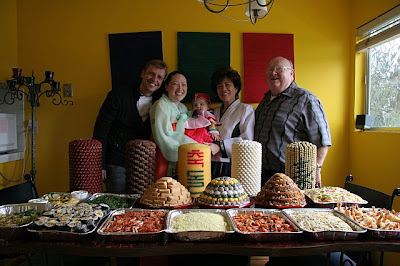 Some of those finds include this photo above taken at Astrid's 1st birthday party at my home, where my dad is standing with us, happy & laughing. It wasn't a keeper since one of the paintings in the background is hanging askew. But crooked painting be damned; when I discovered the photo today my heart leapt...."look it's my dad! And he's so happy!", followed by endless tears.
The last time I saw my dad alive there was no joy, there was no laughter, he wasn't even able to speak to me. Then the very next time I saw him he was dead. So the last images I have of my dad are those last days in the hospital hooked up to tubes. I'm haunted by those memories and of the memory of him in the morgue when I rushed to the hospital to see him.
So when I see photos of him alive in his 70's...looking like my dad...alive...it is such a find. We didn't take lots of photos of my dad. Only now can I see that we didn't take that many photos of him, because he was overweight. Towards the end he had lost a lot of weight, but then he looked sick. So there's a dearth of photos of him.
Going through my photos I've found my dad captured in photos unintentionally. He appears in one that I took of Astrid riding her scooter on the sidewalk in front of my parents' house and my dad is standing in the distance holding his cane in one hand and his pants in the other. This was when he was getting treatments for his bladder cancer and was losing a lot of weight. He had to constantly hold up his pants. In another one, my mom is playing with Astrid in front of a mirror and my dad is captured sitting in a chair to the side. My heart hurts so bad & yet I am so happy to see my dad alive.
There was a vitality to him even when he was overweight and sick. I try to hold onto those memories and block out the painful ones of him dying. The overwhelming urge that comes over me when I see my dad in photos, is that I need to hug him. I wish I had given him more hugs when he was alive. He was a good hugger, and I loved him so much.
 Some of those finds include this photo above taken at Astrid's 1st birthday party at my home, where my dad is standing with us, happy & laughing. It wasn't a keeper since one of the paintings in the background is hanging askew. But crooked painting be damned; when I discovered the photo today my heart leapt...."look it's my dad! And he's so happy!", followed by endless tears.
The last time I saw my dad alive there was no joy, there was no laughter, he wasn't even able to speak to me. Then the very next time I saw him he was dead. So the last images I have of my dad are those last days in the hospital hooked up to tubes. I'm haunted by those memories and of the memory of him in the morgue when I rushed to the hospital to see him.
So when I see photos of him alive in his 70's...looking like my dad...alive...it is such a find. We didn't take lots of photos of my dad. Only now can I see that we didn't take that many photos of him, because he was overweight. Towards the end he had lost a lot of weight, but then he looked sick. So there's a dearth of photos of him.
Going through my photos I've found my dad captured in photos unintentionally. He appears in one that I took of Astrid riding her scooter on the sidewalk in front of my parents' house and my dad is standing in the distance holding his cane in one hand and his pants in the other. This was when he was getting treatments for his bladder cancer and was losing a lot of weight. He had to constantly hold up his pants. In another one, my mom is playing with Astrid in front of a mirror and my dad is captured sitting in a chair to the side. My heart hurts so bad & yet I am so happy to see my dad alive.
There was a vitality to him even when he was overweight and sick. I try to hold onto those memories and block out the painful ones of him dying. The overwhelming urge that comes over me when I see my dad in photos, is that I need to hug him. I wish I had given him more hugs when he was alive. He was a good hugger, and I loved him so much.
Sunday, August 22, 2010
Glasses
I've been wearing glasses since my dad died. The act of putting them on, seeing through them, cleaning them, taking them off - all reminds me of my dad. My dad wore glasses everyday of his life since he was a teenager. He only took them off to sleep, shower, swim, or read. I was constantly cleaning his glasses. There's nothing worse than dirty lenses with smudges on them. And it was one of the few things I could do for him in the hospital to make sure he could see.
I've been a contact lens wearer for years. I'm nearsighted just like my dad. I can see fine up close by everything is blurry far away. I used to only wear my glasses at night. Yet I started wearing glasses during the day when my eyes were getting dry (computer, crying, late nights at the hospital) and it was just way more convenient. No hassle of saline solution to clean them and store them and take them out & put them in twice a day. Since my dad's death I've continued to wear my glasses everyday.
After my dad died, my mom brought some of his belongings to the funeral home, including his glasses. When I saw his glasses (that were tagged with his name) I burst into tears. They so reminded me on him. He always had them on. Seeing them on the table meant he was dead and wouldn't be needing them anymore. My mom asked the funeral Director what her opinion was on burying my dad with his glasses on. She replied, "Did he wear glasses all the time? Well then it wouldn't look like him if he weren't wearing them." At his viewing he was wearing his glasses & he looked like himself...my dad.
I remember the sound of the clink his glasses made when he took them off & put them on the nightstand before reading a book or going to sleep. When I hear the same clink when I set my glasses down I think of my dad.
It's a memory that comforts me. It keeps his memory alive.
I'm getting ready to drive out to Riverside National Cemetery today to visit my dad's grave. I'll be wearing my glasses and thinking of him.
I've been a contact lens wearer for years. I'm nearsighted just like my dad. I can see fine up close by everything is blurry far away. I used to only wear my glasses at night. Yet I started wearing glasses during the day when my eyes were getting dry (computer, crying, late nights at the hospital) and it was just way more convenient. No hassle of saline solution to clean them and store them and take them out & put them in twice a day. Since my dad's death I've continued to wear my glasses everyday.
After my dad died, my mom brought some of his belongings to the funeral home, including his glasses. When I saw his glasses (that were tagged with his name) I burst into tears. They so reminded me on him. He always had them on. Seeing them on the table meant he was dead and wouldn't be needing them anymore. My mom asked the funeral Director what her opinion was on burying my dad with his glasses on. She replied, "Did he wear glasses all the time? Well then it wouldn't look like him if he weren't wearing them." At his viewing he was wearing his glasses & he looked like himself...my dad.
I remember the sound of the clink his glasses made when he took them off & put them on the nightstand before reading a book or going to sleep. When I hear the same clink when I set my glasses down I think of my dad.
It's a memory that comforts me. It keeps his memory alive.
I'm getting ready to drive out to Riverside National Cemetery today to visit my dad's grave. I'll be wearing my glasses and thinking of him.
Monday, August 09, 2010
Homeopathic Bath Remedy
A massage therapist gave me a tip for a homeopathic bathing remedy. No surprise I've got a twinge in my neck & my body is all out of whack. I tried it. It's great. I'm hooked.
Here's the recipe...
Ingredients:
16 oz box of baking soda (pour entire contents into tub)
fill the same box with Epsom salts (pour into the tub)
Fill the bathtub with the hottest water you can withstand just enough to cover your knees
Sit it the water for a bit until you get used to the temperature & then fill the bathtub the rest of the way.
Soak your entire body from the tip of your head to your toes.
Massage those areas where you have pain & are sore.
Afterward don't rinse off - just towel dry lightly & let the salt continue to work it's magic.
So refreshing! It took away a lot of the aches & pains (at least temporarily). Especially the feet which wasn't even on my radar. Wearing high heels all day even in the most comfortable shoes gives you sore feet. After this bath potion, my feet felt great! Plus it's a natural deodorant. No chemicals - just super clean & fresh.
The first time I tried it the water was all cloudy. He said to expect this from the toxins leaving the body. Every time since the water has been clear. And he recommended stretching in the bath & massaging away those knots & getting into the muscle.
Super easy & it helps.
Here's the recipe...
Ingredients:
16 oz box of baking soda (pour entire contents into tub)
fill the same box with Epsom salts (pour into the tub)
Fill the bathtub with the hottest water you can withstand just enough to cover your knees
Sit it the water for a bit until you get used to the temperature & then fill the bathtub the rest of the way.
Soak your entire body from the tip of your head to your toes.
Massage those areas where you have pain & are sore.
Afterward don't rinse off - just towel dry lightly & let the salt continue to work it's magic.
So refreshing! It took away a lot of the aches & pains (at least temporarily). Especially the feet which wasn't even on my radar. Wearing high heels all day even in the most comfortable shoes gives you sore feet. After this bath potion, my feet felt great! Plus it's a natural deodorant. No chemicals - just super clean & fresh.
The first time I tried it the water was all cloudy. He said to expect this from the toxins leaving the body. Every time since the water has been clear. And he recommended stretching in the bath & massaging away those knots & getting into the muscle.
Super easy & it helps.
Wednesday, July 28, 2010
Thinking of you everyday Dad
Dad,
There are so many things I wish I would have said & done. So many things left unsaid. I tried. I really did. When you were alive and I went to visit you on Mondays, over the course of 3 1/2 years I tried to open my heart & tell you how much you meant to me. But it was difficult. Astrid was there with us and the baby needed attention. Lots of interruptions in our conversation ensued. The Alzheimer's took you away a lot of the time & conversations weren't always possible. That would make me so sad. Not wanting to talk about death. Focusing on the present. Trying to deal with the situation & all the stress. On top of that I'm my father's daughter and peeling back all the layers to expose vulnerability is difficult for me.
The doctors kept telling us you were going to die soon. Everyone in the family was in denial, except me. And that tremendous burden was so heavy on me. I'm not complaining. What you went through was so terrible & I wanted so badly to alleviate all of your suffering. I convinced mom that she should tell you that you were dying. It was done out of love.
In the hospital, one day when you were clear headed, Mom and I were on either side of your bed, holding your hands. We didn't know how long the fog would be lifted. We both in our own way told you what was happening and that you would die soon. I'm so glad that we had that conversation with you. We wanted to know your last wishes. We wanted you to share your heart with us. I keep hearing you say, "We just need to get a better doctor." Every time I think about that I burst into tears. It hurts my heart so much because the doctors couldn't do anything for you & all the doctors told us to start preparing for your imminent death. Then you said, "I'm not ready yet. I don't want to say anything that will embarrass myself." Fuck. You were so strong. You were the strongest man I've ever met. You were a different generation. In the end you told us all you wanted was for your family to be there. Mom and I were both bawling our eyes out. I told you how much I appreciated you. I'm so glad I got to tell you while you were alive and mentally there. You heard me and I know it touched your heart. When mom told you to tell me you loved me...I said you didn't have to b/c I already knew. I've always known you loved me dad. There was never any question of that.
You always told me that your dad never told you that he loved you until you were in your late 40's. As tough & old school of a guy you were - that caused you a lot of pain & you never wanted your kid to grow up feeling unloved. So you would tell me - "You know I love you right?" you'd say. "Yes, Dad. I know." I'd say. I'm sure this was accompanied by some eye rolling in my preteen years. And you'd tell me the story of your dad and how you didn't want to make that same mistake.
You gave me unconditional love. You were the first man I ever loved. What a gift to have a father like you who thought the world of me. Growing up you always told me I could do & be whatever I wanted, except be the President of the United States (since I wasn't born in the U.S.), but you didn't think I would want that anyway. And you were right. You gave me self confidence. How I appreciate all those intangibles you instilled in me. It shows in my relationships with others. It shows in my outlook on the world. It shows in my work ethic. It shows in my marriage. It shows in my parenthood.
Not a day goes by that I don't think about you. When I look at my daughter I think of you and want to instill that self confidence and strong foundation you gave me. When I see my husband & daughter together, I think of you. Even when they struggle & have a battle of wills it reminds me of you and I. You raised me to be a strong woman & I'm striving to do the same for my child. I appreciate your life even more.
I miss you so much Dad. It's all about love. I love you & I always knew you loved me.
Sunshine through tall trees
A coworker gave me a sympathy card with a beautiful photo of sunlight streaming in through tall trees in a forest. It reminds me of the forests of Germany. I cried when I saw it. It wasn't a generic sympathy card. My coworker has traveled the world and has a good taste. It shows in his bereavement card. I have the card hanging on my wall. It gives me strength when I look at it. Tomorrow is another day. I will make it a good one.
Tuesday, July 27, 2010
Thoughts of the day
I'm back at work today, yet my mind is miles away. My heart is still heavy. My mind drifts to thoughts of my dad. Tears spring easily to my eyes. I feel like an injured animal limping along. Still so raw with emotion...
My husband responded:
Grieving takes a lot of time. Always remember: death leaves a heartache no can can heal, love leaves a memory no one can steal.
My husband responded:
Grieving takes a lot of time. Always remember: death leaves a heartache no can can heal, love leaves a memory no one can steal.
Friday, July 23, 2010
Anguish
–noun
excruciating or acute distress, suffering, or pain: the anguish of grief.
–verb
to suffer, feel, or exhibit anguish: to anguish over the loss of a loved one.
An Emotional Day
It's been an emotional day. Lots of tears. Been thinking a lot of my dad.
When I got sick, a friend told me she was glad my body felt safe enough to get sick. Wise words from a Yogi (and friend who has been there for me since my dad's death). She's right; there was too much to do & no time to get sick. Everything is over now. It's just me and my thoughts.
I keep thinking of my dad's hands. He had these amazing hands. His large palms were thick & calloused from hard labor. I received lots of spankings from those hands. I watched those hands work with tools - a wrench, a screwdriver. I can see his hands being dirty after working on the car, or plumbing, or whatever it was he had just finished fixing. I can see him washing his hands in the sink afterward to get them clean again. I can see his hands typing with one finger. I held those hands so many times. As a kid they gave me great comfort. They made me feel safe. As an adult I held those hands to let my dad know everything would be okay, when there were no words to express the moment, to let him know I was there by his side & to express my love.
In a High School graduation photo, standing next to my dad I realized for the first time that our hands were similar in shape, mine being the female equivalent. My brother reminded me of this recently and it made me feel close to my dad.
Lots of thoughts of my dad. Like the "goulash" he would make, which has no resemblance to any goulash I've eaten in my life. It consisted of ground hamburger, a can of corn, and ketchup, all mixed in a frying pan. I could go for some of that goulash right about now. He also taught me how to make grilled cheese sandwiches. So many memories.
My dad's death has given me a good kick in the butt. I will be a better parent, wife, friend, human being as a result. I will not shy away from opportunities. I will tell my loved ones how much I love them everyday. Life is too short.
When I got sick, a friend told me she was glad my body felt safe enough to get sick. Wise words from a Yogi (and friend who has been there for me since my dad's death). She's right; there was too much to do & no time to get sick. Everything is over now. It's just me and my thoughts.
I keep thinking of my dad's hands. He had these amazing hands. His large palms were thick & calloused from hard labor. I received lots of spankings from those hands. I watched those hands work with tools - a wrench, a screwdriver. I can see his hands being dirty after working on the car, or plumbing, or whatever it was he had just finished fixing. I can see him washing his hands in the sink afterward to get them clean again. I can see his hands typing with one finger. I held those hands so many times. As a kid they gave me great comfort. They made me feel safe. As an adult I held those hands to let my dad know everything would be okay, when there were no words to express the moment, to let him know I was there by his side & to express my love.
In a High School graduation photo, standing next to my dad I realized for the first time that our hands were similar in shape, mine being the female equivalent. My brother reminded me of this recently and it made me feel close to my dad.
Lots of thoughts of my dad. Like the "goulash" he would make, which has no resemblance to any goulash I've eaten in my life. It consisted of ground hamburger, a can of corn, and ketchup, all mixed in a frying pan. I could go for some of that goulash right about now. He also taught me how to make grilled cheese sandwiches. So many memories.
My dad's death has given me a good kick in the butt. I will be a better parent, wife, friend, human being as a result. I will not shy away from opportunities. I will tell my loved ones how much I love them everyday. Life is too short.
Thursday, July 22, 2010
Helping Astrid deal with her grief
My 5 year old daughter still cries for her Grandpa and misses him. It breaks my heart. It's difficult enough for me, her mother, to understand death. I understand it physically but am still dealing with my own emotions surrounding it. For a 5 year old, it must be even more difficult for her to comprehend.
Today she told me she wants to have a picture of Grandpa in her room. After my dad died, my brother and I poured through photo albums longing to reconnect with my dad. She's at that stage too where she wants to hold onto memories of him. Missing him and wanting to be with him in whatever way possible, even if it is just through memories.
My husband and I discussed it tonight and think it would be nice to frame a photo of my dad for Astrid to hang in her room. We'd all feel a little closer to him that way.
Today she told me she wants to have a picture of Grandpa in her room. After my dad died, my brother and I poured through photo albums longing to reconnect with my dad. She's at that stage too where she wants to hold onto memories of him. Missing him and wanting to be with him in whatever way possible, even if it is just through memories.
My husband and I discussed it tonight and think it would be nice to frame a photo of my dad for Astrid to hang in her room. We'd all feel a little closer to him that way.
Still thinking of you
Dad,
I was in the pharmacy today. All of the stress finally caught up with me and I came down with the flu & a really bad infection of my tonsils. So as I'm waiting for the Pharmacist to fill my prescription, I started looking around at all the orthopedic devices and aides. I caught myself thinking about what I could get you. What would you need? What would help you?
I remember when I bought you your cane. A similar thought, different day - "My dad could really use a cane like that." And you loved that cane with the padded handle. I was afraid that with your Alzheimer's you wouldn't remember it, instead remembering your old cane, but for whatever reason you only remembered that new black cane I bought for you. "This is a good cane," you said. You always kept it by your side and it was the first thing you looked for when you woke up from a nap. That made me feel really good. That I could do something for you. That I could help you in some small way with all that you were going through.
Today I was standing there, staring up at the orthopedic devices with tears in my eyes. There's nothing I can do for you. That makes me really sad. You will always be my dad. I will always be your daughter. And I will always love you.
I was in the pharmacy today. All of the stress finally caught up with me and I came down with the flu & a really bad infection of my tonsils. So as I'm waiting for the Pharmacist to fill my prescription, I started looking around at all the orthopedic devices and aides. I caught myself thinking about what I could get you. What would you need? What would help you?
I remember when I bought you your cane. A similar thought, different day - "My dad could really use a cane like that." And you loved that cane with the padded handle. I was afraid that with your Alzheimer's you wouldn't remember it, instead remembering your old cane, but for whatever reason you only remembered that new black cane I bought for you. "This is a good cane," you said. You always kept it by your side and it was the first thing you looked for when you woke up from a nap. That made me feel really good. That I could do something for you. That I could help you in some small way with all that you were going through.
Today I was standing there, staring up at the orthopedic devices with tears in my eyes. There's nothing I can do for you. That makes me really sad. You will always be my dad. I will always be your daughter. And I will always love you.
Wednesday, July 14, 2010
A lock of your hair
Huddled around the table in the funeral home, when asked if we wanted a lock of your hair, the three of us looked at each other and Bernard Jr. said, "He didn't have any hair." Then my mom said "No. What for?" And I got choked with emotion and said "Yes, I want it."
The funeral director crossed out "0" and wrote in "1" on the request form for the mortuary.
My brother was right, my dad didn't have much hair. He had a little crown of hair, Julius Cesar style, which my mom kept short. Because of this I kept picturing my dad with a bald spot on the back of his head where they'd most likely shave it to give me a lock of his hair.
They presented it to my mom today at the viewing and she gave it to me. "Here's your dad's hair that you wanted," she said. Looking at it later back at the house that evening, I saw that they did NOT shave it. It was just a messy cutting with hair spilling out of a tiny plastic bag, glued to a piece of paper with his name on it, presented by Inland Memorial.
I'm glad that I asked for it. It's good to know that if I ever need genetic testing done they won't have to exume the body, since I have his DNA via his hair clippings. And on a more emotional level it's just a small momento of him. Something that no one else wanted but me.
The funeral director crossed out "0" and wrote in "1" on the request form for the mortuary.
My brother was right, my dad didn't have much hair. He had a little crown of hair, Julius Cesar style, which my mom kept short. Because of this I kept picturing my dad with a bald spot on the back of his head where they'd most likely shave it to give me a lock of his hair.
They presented it to my mom today at the viewing and she gave it to me. "Here's your dad's hair that you wanted," she said. Looking at it later back at the house that evening, I saw that they did NOT shave it. It was just a messy cutting with hair spilling out of a tiny plastic bag, glued to a piece of paper with his name on it, presented by Inland Memorial.
I'm glad that I asked for it. It's good to know that if I ever need genetic testing done they won't have to exume the body, since I have his DNA via his hair clippings. And on a more emotional level it's just a small momento of him. Something that no one else wanted but me.
Monday, July 12, 2010
50's music reminds me of you dad
Dad,
I've found myself listening to a lot of 50's music after your death. It reminds me of you. You graduated from high school in 1952. It was a simpler time when you were young and healthy. You had your whole life ahead of you. I used to turn to the 50's radio channel for you when you were in the car with me, driving to your doctors appointments, hoping it would trigger a fond memory of your past. Bernard Jr. & I recently went through your old high school yearbooks looking at all the vintage photos. The 1950's era makes me think of you & all the promise your life held. Thinking of you young & healthy, rather than old & sick.
Your funeral is tomorrow
Dad,
Your funeral is tomorrow. The earliest day/time we could reserve with the National Cemetery in Riverside is tomorrow at 11:45 AM. We're able to have your viewing earlier that day to have both on one day. After the ceremony friends & family will meet at Mission Inn Restaurant in Riverside. It's a beautiful location that I would have loved to have taken you to when you were alive. I hope you will be there with us in spirit feeling our love for you & overhearing all the nice things people will be saying about you.
I'm looking forward to it & at the same time dreading all the same things:
*Seeing you for the last time
*Seeing relatives I haven't seen since the last funeral or my wedding 9 years ago
*Helping my daughter to understand your death & the celebration we will be having to honor your life
*You being placed in the ground, your last resting place
The funeral is supposed to give me closure. I doubt it will give me that.
Right now I'm dealing with all the final details - contacting family & friends who will be attending the funeral, buying navy blue dresses for your granddaughters, picking up dry cleaning. All those mundane things.
I'm also going over to your house today to spend time with Mom & Bernard, Jr. I stumbled when I tried to tell Astrid where we were going today. When you were alive I always referred to your home as "Grandpa's house" or "Grandma & Grandpa's house." Today I referred to it as "Grandma's house" and Astrid corrected me - "You mean Grandma AND Grandpa's house," she said. I told her it was now "Grandma's house" since you're no longer with us. But I still feel like it's your house. Tears well up in my eyes when I think of all the memories in that house, and I can still see your clothes and hat hanging from the rack waiting for you to return.
Your funeral is tomorrow. The earliest day/time we could reserve with the National Cemetery in Riverside is tomorrow at 11:45 AM. We're able to have your viewing earlier that day to have both on one day. After the ceremony friends & family will meet at Mission Inn Restaurant in Riverside. It's a beautiful location that I would have loved to have taken you to when you were alive. I hope you will be there with us in spirit feeling our love for you & overhearing all the nice things people will be saying about you.
I'm looking forward to it & at the same time dreading all the same things:
*Seeing you for the last time
*Seeing relatives I haven't seen since the last funeral or my wedding 9 years ago
*Helping my daughter to understand your death & the celebration we will be having to honor your life
*You being placed in the ground, your last resting place
The funeral is supposed to give me closure. I doubt it will give me that.
Right now I'm dealing with all the final details - contacting family & friends who will be attending the funeral, buying navy blue dresses for your granddaughters, picking up dry cleaning. All those mundane things.
I'm also going over to your house today to spend time with Mom & Bernard, Jr. I stumbled when I tried to tell Astrid where we were going today. When you were alive I always referred to your home as "Grandpa's house" or "Grandma & Grandpa's house." Today I referred to it as "Grandma's house" and Astrid corrected me - "You mean Grandma AND Grandpa's house," she said. I told her it was now "Grandma's house" since you're no longer with us. But I still feel like it's your house. Tears well up in my eyes when I think of all the memories in that house, and I can still see your clothes and hat hanging from the rack waiting for you to return.
Looking for an e-mail from you
Dad,
I went through my inbox today looking for an e-mail from you. The last time you e-mailed me was over 4 years ago, before the Alzheimer's interfered with your ability to use the computer. Your e-mail address was bmhook@juno.com. I remember you used to type in all caps and your e-mails were brief. How I long to read one of those e-mails again. Usually it was a photo of Astrid I sent you, or maybe a joke or something. You'd print out photos of Astrid & post them on your office wall. When you'd respond back you'd always end your e-mails by telling me you loved me. So sad I could not find one. I must have deleted them after reading them years ago, not knowing how one day I would long to get an e-mail from you.
I love you dad.
I went through my inbox today looking for an e-mail from you. The last time you e-mailed me was over 4 years ago, before the Alzheimer's interfered with your ability to use the computer. Your e-mail address was bmhook@juno.com. I remember you used to type in all caps and your e-mails were brief. How I long to read one of those e-mails again. Usually it was a photo of Astrid I sent you, or maybe a joke or something. You'd print out photos of Astrid & post them on your office wall. When you'd respond back you'd always end your e-mails by telling me you loved me. So sad I could not find one. I must have deleted them after reading them years ago, not knowing how one day I would long to get an e-mail from you.
I love you dad.
Sunday, July 11, 2010
A good day with dad (I'd give anything for one more day with you)
Dad,
You passed away on Sunday, July 4, 2010, a week ago. Your viewing & funeral will take place on Tuesday, July 13, 2010, the first available date for burial in the National Cemetery. It gives me some comfort to know I will see you one last time in your uniform with your medals and ribbons, before you are buried. And I know you would get a kick out of the taps style military funeral you will receive at the National Cemetery. Yet, my heart aches to go back in time and spend one more good day with you.
I tried to describe my longing to U. and he told me that all of us want to have that last conversation. While that would be nice, to be able to say all the things to you that I wasn't able to; I know you know that I loved you very much. You knew ever since I was a kid that I adored you. I know you loved me too. When you were diagnosed with Alzheimer's over 3 years ago and your memory was failing, you didn't have to ask -I was there spending every Monday with you, bringing Astrid with me. "Remember I visit you every Monday Dad." When you were diagnosed with bladder cancer I took you to your doctors appointments, to radiation, and tried my best to care for you. God damn I miss those Mondays. I didn't know how good I had it, to be able to spend so much time with you. And at the end when you were in the hospital, I tried my best to care for you with warm blankets to keep you warm and held your hand.
What I'm really longing for is just one more summer day with you when you were able to sit outside in the backyard with me, watching your granddaughter swim in the baby pool. I wouldn't have to say a thing. I just want to spend the day with you. Hear your voice. Hear you laugh. Feel your warm bear hug. Smell your Old Spice. See the light in your eyes as they shine with happiness at spending an ordinary sunny day with your daughter & granddaughter.
 You used to sneak over to my place after Astrid was born. I had flashbacks when I saw you feeding her, as you used to feed me as a child. The air conditioning didn't work well & the house would be hot as an oven during the summer, yet you didn't mind. You just loved sitting with me, shooting the breeze, watching your granddaughter.
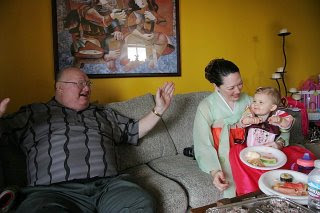 You came over to celebrate Astrid's 1st birthday and cracked a joke that she made a good Korean in her costume. You also told me I looked pretty that day. I was the apple of your eye and your favorite I know. It hurts so much to not have you here cracking jokes. Today I'd happily even listen to your bad jokes, or ones that I'd heard hundreds of times. You had such a larger than life personality, it's still hard to fathom that you're gone.
In the photo above you're telling Astrid you love her "This much!".
 I would bring Astrid over every Monday and we would spend the day together. Here you are reading to her. Christmas of 2008 I put together a Kodak photo album for you with this and other photos of you and Astrid together so that you would remember her. Now she remembers you. She misses you and still cries sometimes.
While driving in the car the other day after your death Astrid had this thought, "Oh no mom! Who are we going to have lunch with on Mondays now?" It was such a big part of our life. No matter how bad you were feeling, you somehow rallied, got dressed and went to lunch with us. Even when your feet were so swollen you couldn't wear your shoes, you put on open toed sandals and went with us. Usually it was our favorite Vietnamese restaurant next to Stater Bros. You loved their grilled chicken, accompanied with a diet Pepsi to drink. I went there the other day with mom & Bernard and I couldn't shake the feeling that you should have been there with us.
 This is the kind of summer day I would give anything to have with you. You're sitting out in the backyard leaning against your cane, watching Astrid who is playing with Cathy. Gosh how I miss those days. Mondays were for you. Unfortunately you died on a Sunday, the day before I was supposed to spend the entire day with you. That still hurts my heart so much.
A friend told me that my grief & how much my heart longs to be with you again, is a testament to how much you were loved.
You had children late in life with me & Bernard being your miracle babies. Looking at these photos, reminds me how fortunate I was to have you in my life for 36 years.
I love you & miss you Dad.
You passed away on Sunday, July 4, 2010, a week ago. Your viewing & funeral will take place on Tuesday, July 13, 2010, the first available date for burial in the National Cemetery. It gives me some comfort to know I will see you one last time in your uniform with your medals and ribbons, before you are buried. And I know you would get a kick out of the taps style military funeral you will receive at the National Cemetery. Yet, my heart aches to go back in time and spend one more good day with you.
I tried to describe my longing to U. and he told me that all of us want to have that last conversation. While that would be nice, to be able to say all the things to you that I wasn't able to; I know you know that I loved you very much. You knew ever since I was a kid that I adored you. I know you loved me too. When you were diagnosed with Alzheimer's over 3 years ago and your memory was failing, you didn't have to ask -I was there spending every Monday with you, bringing Astrid with me. "Remember I visit you every Monday Dad." When you were diagnosed with bladder cancer I took you to your doctors appointments, to radiation, and tried my best to care for you. God damn I miss those Mondays. I didn't know how good I had it, to be able to spend so much time with you. And at the end when you were in the hospital, I tried my best to care for you with warm blankets to keep you warm and held your hand.
What I'm really longing for is just one more summer day with you when you were able to sit outside in the backyard with me, watching your granddaughter swim in the baby pool. I wouldn't have to say a thing. I just want to spend the day with you. Hear your voice. Hear you laugh. Feel your warm bear hug. Smell your Old Spice. See the light in your eyes as they shine with happiness at spending an ordinary sunny day with your daughter & granddaughter.
 You used to sneak over to my place after Astrid was born. I had flashbacks when I saw you feeding her, as you used to feed me as a child. The air conditioning didn't work well & the house would be hot as an oven during the summer, yet you didn't mind. You just loved sitting with me, shooting the breeze, watching your granddaughter.
 You came over to celebrate Astrid's 1st birthday and cracked a joke that she made a good Korean in her costume. You also told me I looked pretty that day. I was the apple of your eye and your favorite I know. It hurts so much to not have you here cracking jokes. Today I'd happily even listen to your bad jokes, or ones that I'd heard hundreds of times. You had such a larger than life personality, it's still hard to fathom that you're gone.
In the photo above you're telling Astrid you love her "This much!".
 I would bring Astrid over every Monday and we would spend the day together. Here you are reading to her. Christmas of 2008 I put together a Kodak photo album for you with this and other photos of you and Astrid together so that you would remember her. Now she remembers you. She misses you and still cries sometimes.
While driving in the car the other day after your death Astrid had this thought, "Oh no mom! Who are we going to have lunch with on Mondays now?" It was such a big part of our life. No matter how bad you were feeling, you somehow rallied, got dressed and went to lunch with us. Even when your feet were so swollen you couldn't wear your shoes, you put on open toed sandals and went with us. Usually it was our favorite Vietnamese restaurant next to Stater Bros. You loved their grilled chicken, accompanied with a diet Pepsi to drink. I went there the other day with mom & Bernard and I couldn't shake the feeling that you should have been there with us.
 This is the kind of summer day I would give anything to have with you. You're sitting out in the backyard leaning against your cane, watching Astrid who is playing with Cathy. Gosh how I miss those days. Mondays were for you. Unfortunately you died on a Sunday, the day before I was supposed to spend the entire day with you. That still hurts my heart so much.
A friend told me that my grief & how much my heart longs to be with you again, is a testament to how much you were loved.
You had children late in life with me & Bernard being your miracle babies. Looking at these photos, reminds me how fortunate I was to have you in my life for 36 years.
I love you & miss you Dad.
Support & Grief
When something terrible happens - a crisis, a death, an illness - you need support from others. A friend of mine whose son had a terrible accident & almost died and also went through the painful experience of caring for her mother who died of cancer - said that she now knows what to do. I feel the same way now. I didn't used to know what to do or say or how to support others going through a crisis, tragedy, loss, etc. Now having gone through it myself with the death of my father, I know what to do. I'll be there. I'll come over. I'll give support & speak from my heart.
The day after my dad died was a holiday. Everything was closed, including the funeral home. I felt so useless. There was nothing I could do. I had to sit and wait. I cried & cried until I thought I had no tears left. I didn't know what to do. A friend came over that day to sit with me. She brought flowers and gave me a big hug. It was so good to have her over. If it weren't for her I would have been staring out in space all day, alone with my grief. She was there for me. I cannot thank her enough. It meant so much to me.
Also, kindness from strangers - I'm FB friends with the sister & mom of a boy I went to school with. I've never met them. Yet they poured their hearts out to me sharing their experiences with the loss of their father and are coming to the funeral to support me. This was completely unexpected, yet welcomed. The mom wrote me and said I probably wouldn't recognize them at the funeral, yet they'd be there with their hearts waving at me. I was so touched.
Phone calls, texts, offers to buy groceries/do laundry, even one friend I haven't seen in ages, invited me & my family up to his 15 acre ranch for the weekend. I happily took him up on his offer. It will be great to get away.
Then there are those friends you thought for sure would be there and there's only deafening silence. Disappointing. Yet, luckily the people who come out of the woodwork tip the scales to offer their support with so many pleasant surprises.
Tips:
1) If you knew the deceased, share a nice memory. It gives so much comfort to the loved one who is grieving (rather than just "sorry for your loss").
2) Show up. Many ppl think they should leave the grieving person alone since they have a lot to deal with. Here's a fact: NO one wants to be alone when they're grieving. Just having a friend there to talk to helps so much.
3) Check in. Let them know you are thinking of them.
4) Share your experience. If you've lost your father - share that with a friend who experiencing the same loss.
5) Be there for the person & let the person grieve. The last thing a grieving person needs are reminders that the world is moving on so quickly after a recent death of a loved one.
6) Show genuine interest & concern. It's not a time to share the latest & greatest happening in your life, expecting the grieving person to be happy for you. You can chat about that later. It may come from a good place, yet is so inappropriate. A grieving person is overwhelmed with emotion, pain & loss. My husband referred to me as a clown "Trying to keep up the smile, but with great sadness underneath." Acknowledge the sadness.
The day after my dad died was a holiday. Everything was closed, including the funeral home. I felt so useless. There was nothing I could do. I had to sit and wait. I cried & cried until I thought I had no tears left. I didn't know what to do. A friend came over that day to sit with me. She brought flowers and gave me a big hug. It was so good to have her over. If it weren't for her I would have been staring out in space all day, alone with my grief. She was there for me. I cannot thank her enough. It meant so much to me.
Also, kindness from strangers - I'm FB friends with the sister & mom of a boy I went to school with. I've never met them. Yet they poured their hearts out to me sharing their experiences with the loss of their father and are coming to the funeral to support me. This was completely unexpected, yet welcomed. The mom wrote me and said I probably wouldn't recognize them at the funeral, yet they'd be there with their hearts waving at me. I was so touched.
Phone calls, texts, offers to buy groceries/do laundry, even one friend I haven't seen in ages, invited me & my family up to his 15 acre ranch for the weekend. I happily took him up on his offer. It will be great to get away.
Then there are those friends you thought for sure would be there and there's only deafening silence. Disappointing. Yet, luckily the people who come out of the woodwork tip the scales to offer their support with so many pleasant surprises.
Tips:
1) If you knew the deceased, share a nice memory. It gives so much comfort to the loved one who is grieving (rather than just "sorry for your loss").
2) Show up. Many ppl think they should leave the grieving person alone since they have a lot to deal with. Here's a fact: NO one wants to be alone when they're grieving. Just having a friend there to talk to helps so much.
3) Check in. Let them know you are thinking of them.
4) Share your experience. If you've lost your father - share that with a friend who experiencing the same loss.
5) Be there for the person & let the person grieve. The last thing a grieving person needs are reminders that the world is moving on so quickly after a recent death of a loved one.
6) Show genuine interest & concern. It's not a time to share the latest & greatest happening in your life, expecting the grieving person to be happy for you. You can chat about that later. It may come from a good place, yet is so inappropriate. A grieving person is overwhelmed with emotion, pain & loss. My husband referred to me as a clown "Trying to keep up the smile, but with great sadness underneath." Acknowledge the sadness.
Today I ran for the first time since my dad died
My dad had a long battle with his health and various illnesses. There's a long list, yet in the end it was Alzheimer's and bladder cancer.
I took up running as a positive way to deal with the stress. Beginning 1/1/2010 I started training for a triathlon. The running portion of the mini-tri at Hanson Dam in August is 3 miles. For me a non-runner, a 3 mile run seemed unattainable. I could barely run half a mile. After a few months I felt ready to attempt a run around the Rose Bowl which is a 3.12 mile run. This route was something I had attempted to run around in the past & always had to stop after about a mile with a sharp pain in my side, and had to walk the rest. My goal was to continue running around the Rose Bowl without stopping, to complete the loop. I was prepared for disappointment. If I couldn't do it, I'd head right back to the gym & hit the treadmill. Yet what was so funny was I completed the loop, saw my car where I had started the run and thought, "Is that it?" My body was ready to run another mile. In my mind the distance was so much farther. That gave me a lot of confidence. I could do it!
I started to love running. Running around the Rose Bowl was a piece of cake. When traveling to Europe in May I ran through the forests in Germany for 4.5 miles. A friend referred to me as a "runner", which was the ultimate compliment. I started thinking about running more outdoors, and which running paths had the nicest views, etc.
So I continued to run and bike, 3 times a week (with Yoga on Sundays) and kept up with it for 6+ months. I had just started the swimming portion of the training, when my dad passed away on 7/4/2010. I stopped running. I stopped training. I didn't even think about running.
Until my husband said, "You need to start running again. It's good for your body & your head," tapping his temple on the side of his head.
So yesterday I attempted to run again for the first time since my dad died. My dad died on Sunday so 6 days after his death. I put on my headphones like usual, and got my heart rate up & legs pumping. As I was running I thought of my dad and my body started sobbing. I felt like I was literally crying out of every single pore of my body. I barely made it to 2 miles. My pulse was over 190. Someone once told me 180 was cardiac arrest.
Will I continue running? I don't know. It was such a help to deal with the stress of his illness & all the worry with his health worsening & caring for him. Now that he's dead I don't know if I want to keep running. I would love to think that I'd continue running & see the benefits. Who knows. Maybe I'll be like Forest Gump and hang up my sneakers. Or maybe I'll take up something new like kick boxing or something to get out all my frustration & anger. I don't know. I just know it was really sad to run again today. Afterward my face was the reddest I've ever seen it. I just kept thinking of my dad & how he's gone forever.
I took up running as a positive way to deal with the stress. Beginning 1/1/2010 I started training for a triathlon. The running portion of the mini-tri at Hanson Dam in August is 3 miles. For me a non-runner, a 3 mile run seemed unattainable. I could barely run half a mile. After a few months I felt ready to attempt a run around the Rose Bowl which is a 3.12 mile run. This route was something I had attempted to run around in the past & always had to stop after about a mile with a sharp pain in my side, and had to walk the rest. My goal was to continue running around the Rose Bowl without stopping, to complete the loop. I was prepared for disappointment. If I couldn't do it, I'd head right back to the gym & hit the treadmill. Yet what was so funny was I completed the loop, saw my car where I had started the run and thought, "Is that it?" My body was ready to run another mile. In my mind the distance was so much farther. That gave me a lot of confidence. I could do it!
I started to love running. Running around the Rose Bowl was a piece of cake. When traveling to Europe in May I ran through the forests in Germany for 4.5 miles. A friend referred to me as a "runner", which was the ultimate compliment. I started thinking about running more outdoors, and which running paths had the nicest views, etc.
So I continued to run and bike, 3 times a week (with Yoga on Sundays) and kept up with it for 6+ months. I had just started the swimming portion of the training, when my dad passed away on 7/4/2010. I stopped running. I stopped training. I didn't even think about running.
Until my husband said, "You need to start running again. It's good for your body & your head," tapping his temple on the side of his head.
So yesterday I attempted to run again for the first time since my dad died. My dad died on Sunday so 6 days after his death. I put on my headphones like usual, and got my heart rate up & legs pumping. As I was running I thought of my dad and my body started sobbing. I felt like I was literally crying out of every single pore of my body. I barely made it to 2 miles. My pulse was over 190. Someone once told me 180 was cardiac arrest.
Will I continue running? I don't know. It was such a help to deal with the stress of his illness & all the worry with his health worsening & caring for him. Now that he's dead I don't know if I want to keep running. I would love to think that I'd continue running & see the benefits. Who knows. Maybe I'll be like Forest Gump and hang up my sneakers. Or maybe I'll take up something new like kick boxing or something to get out all my frustration & anger. I don't know. I just know it was really sad to run again today. Afterward my face was the reddest I've ever seen it. I just kept thinking of my dad & how he's gone forever.
Saturday, July 10, 2010
Gravestone inscription
I've been tasked with my dad's gravestone inscription. Actually I volunteered for this. I envisioned writing something unique & personal that would set my dad's gravestone apart from everyone else's in the cemetery. Problem is, I'm limited to 22 spaces.
How do you sum up your dad's life & your love for him in 22 spaces? Examples given on the form from Riverside National Cemetery include: 1) Forever in our hearts, and 2) Mom & Dad loved by all.
I've spent the last few days wracking my brain trying to think of something personal to write. At first my dilemma was - How do I put into words how much my dad, the first man I ever loved meant to me? The last thing I want is a generic saying. When leaving the funeral home (with form in hand) my brother said to me, "You can write it. I trust you. Just as long as it mentions husband, dad & grandpa I'll be happy." He & my mom gave me their blessing to write whatever I wanted, without having to get their final approval on it. Reiterate - problem is I am limited to 22 spaces! That doesn't allow for much creativity. "Husband, Dad & grandpa" is 22 characters alone.
So here is what I came up with:
Loved Yobo/Dad/Grandpa
Yobo is Korean for "spouse". My mom & dad referred to each other as "Yobo" throughout their almost 40 years of marriage. When I hear my mom mention "Yobo" I immediately think of my dad.
Although it saddens me that I can't put more words down - at least it's unique to my dad. He was married to a Korean woman (my mom), lived in Korea while stationed in the Air Force, and had 2 Amerasian children. The Yobo is a tribute to my mom as well, acknowledging her influence in his life.
I think my dad would understand and he'd love the "Yobo" reference.
How do you sum up your dad's life & your love for him in 22 spaces? Examples given on the form from Riverside National Cemetery include: 1) Forever in our hearts, and 2) Mom & Dad loved by all.
I've spent the last few days wracking my brain trying to think of something personal to write. At first my dilemma was - How do I put into words how much my dad, the first man I ever loved meant to me? The last thing I want is a generic saying. When leaving the funeral home (with form in hand) my brother said to me, "You can write it. I trust you. Just as long as it mentions husband, dad & grandpa I'll be happy." He & my mom gave me their blessing to write whatever I wanted, without having to get their final approval on it. Reiterate - problem is I am limited to 22 spaces! That doesn't allow for much creativity. "Husband, Dad & grandpa" is 22 characters alone.
So here is what I came up with:
Loved Yobo/Dad/Grandpa
Yobo is Korean for "spouse". My mom & dad referred to each other as "Yobo" throughout their almost 40 years of marriage. When I hear my mom mention "Yobo" I immediately think of my dad.
Although it saddens me that I can't put more words down - at least it's unique to my dad. He was married to a Korean woman (my mom), lived in Korea while stationed in the Air Force, and had 2 Amerasian children. The Yobo is a tribute to my mom as well, acknowledging her influence in his life.
I think my dad would understand and he'd love the "Yobo" reference.
Goodbye Facebook & hello again blog
After my dad passed away on the 4th of July, 2010 I was so filled with sadness & grief and longing to reconnect with him (still am) that I took to Facebook and wrote about his passing & posted some old vintage photos of him. I asked my husband, "Is it too much? Or okay?" He responded that it was just fine. Yet after a few posts he said to me, "You may want to start blogging again. People don't know how to respond to grief and anyway Facebook should be kept light."
So here I am back to my blog away from home. I hope that blogging will help me through my grief, both in mourning the loss of my dad's life & sharing my experience with others. No one knows how painful it is to lose a parent, until it happens to you. No amount of preparation can prepare you for the pain you will experience when it happens. As my husband describes it, "It's like getting kicked in the balls." It brings you to your knees emotionally.
So as I feel the need to get things off my chest, I will be blogging away. In essence resurrecting this blog. I'll continue to post on FB with more lighthearted material like pics of my daughter & what events I'm attending. Friends can click on the "like" button and see what I'm up to. Blogging will be more cathartic in nature, helping me speak from my soul, so that only those interested in reading it can, and those who would rather not be bothered, won't be.
So here I am back to my blog away from home. I hope that blogging will help me through my grief, both in mourning the loss of my dad's life & sharing my experience with others. No one knows how painful it is to lose a parent, until it happens to you. No amount of preparation can prepare you for the pain you will experience when it happens. As my husband describes it, "It's like getting kicked in the balls." It brings you to your knees emotionally.
So as I feel the need to get things off my chest, I will be blogging away. In essence resurrecting this blog. I'll continue to post on FB with more lighthearted material like pics of my daughter & what events I'm attending. Friends can click on the "like" button and see what I'm up to. Blogging will be more cathartic in nature, helping me speak from my soul, so that only those interested in reading it can, and those who would rather not be bothered, won't be.
Bernard M. Hook, Sr. Memorial Fund
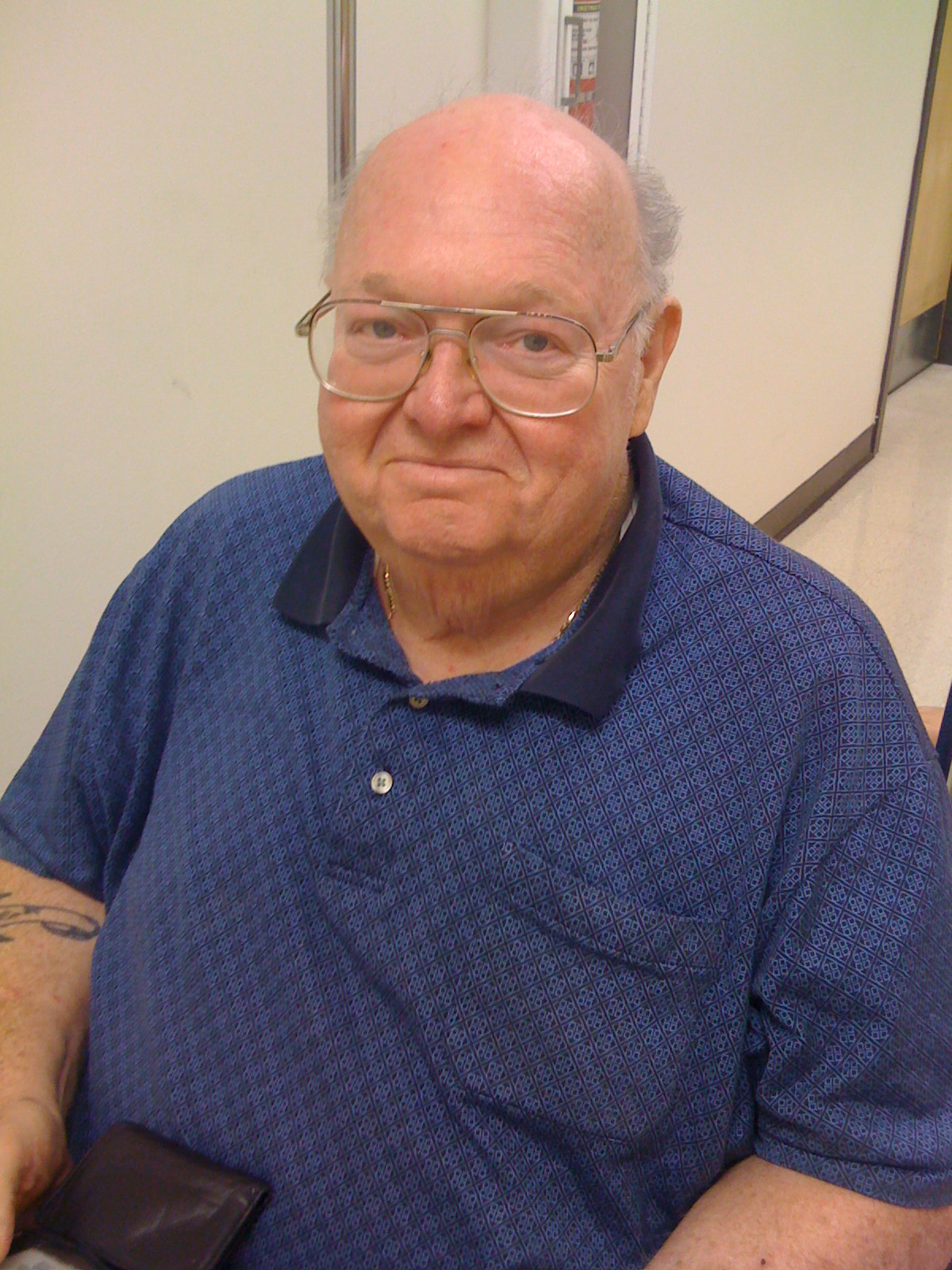 My father, Bernard M. Hook, Sr. (1934-2010), was a Shriner for many decades. The charity work he did for children was something he felt really good about. After retiring he volunteered as a Shriners Clown, making children smile with balloon animals, stickers & warm hugs.
In his loving memory, my family is asking that in lieu of flowers, donations be made in his name to the Shriners Hospital for Children to continue his philanthropic work to make a difference in the lives of children.
Below is a link to his memorial page to make an online contribution.
http://support.shrinershospitals.org/site/TR/Events/General?pg=fund&fr_id=1030&pxfid=1920
Thank you.
Thursday, July 08, 2010
Happy birthday Dad. You would have been 76!
Dad,
You died 4 days before your 76th birthday. We had hoped you would hang in there to turn 76, yet it was your time to go on the 4th of July 2010, shortly before 4 PM. Watching the fireworks will never be the same for me.
To honor your memory, I had the family over today at my house for a bbq. Me, U., Mom, Bernard Jr. and both of your grand daughters. U. grilled a small feast. We shared memories of you, ate, drank and U. gave a toast to you while mom shouted up to the sky, "Happy Birthday Yobo".
We miss you. We love you. You are in our hearts forever.
You died 4 days before your 76th birthday. We had hoped you would hang in there to turn 76, yet it was your time to go on the 4th of July 2010, shortly before 4 PM. Watching the fireworks will never be the same for me.
To honor your memory, I had the family over today at my house for a bbq. Me, U., Mom, Bernard Jr. and both of your grand daughters. U. grilled a small feast. We shared memories of you, ate, drank and U. gave a toast to you while mom shouted up to the sky, "Happy Birthday Yobo".
We miss you. We love you. You are in our hearts forever.
Funeral for Bernard Hook
My dad will have a military funeral ceremony at the National Cemetery in Riverside, with full honors. Friends are welcome to attend.
Details:Tuesday 7/13/2010
11:45 AM
Riverside National Cemetery - Stage 4
22495 Van Buren Blvd.
Riverside, CA 92518
Wednesday, July 07, 2010
My dad's military ribbons & medals

My dad served in the U.S. Air Force for 20+ years & retired honorably as a Master Sergeant. My family decided that he should be buried in his full military uniform with his ribbons on his jacket & medals displayed in his coffin.
 My dad's ribbons awarded over his 20+ year career in the Air Force.
 Some of my dad's military medals.
Miss being by your side dad

Dad, you've been gone just 2 days & I'm longing to connect with you & to keep memories of you close to my heart. Looking through old photos I found this one of you & I on a camping trip long ago at the lake. I remember how much you loved to go fishing. As a kid & as an adult, I loved being by your side.
I miss you Dad.
I miss you Dad.
Tuesday, July 06, 2010
My dad young, healthy & handsome - RIP
 My dad, Bernard M. Hook, Sr. dressed in his U.S. Air Force fatigues.
 Young, healthy & handsome.
1934-2010. RIP
Monday, July 05, 2010
Dream a little dream for me
Dad, remembering how you grilled the best bbq chicken on 4th of July's past, adding your secret ingredient...beer. Wish you could have seen the fireworks one last time. I saw them exploding in the sky all around the hospital. Feels surreal that you're gone. Love you so much. Sweet dreams.
Sunday, July 04, 2010
Dad's passing on the 4th of July 2010
My dad passed away today. He was the toughest guy that I've ever known. He will be missed terribly. I have so much love for him & I will always be Daddy's little girl.
Thursday, July 01, 2010
As Tears Go By
Heartfelt favorite of mine. How the world can continue to go on as usual while my loved one is dying is something I'm grappling with.
Monday, December 21, 2009

Monday, September 14, 2009
Burning Man 2009
My first Burning Man experience. After 10 years of wanting to go, I finally went this year with my husband. So glad I did. It was a wonderful experience.
 A lit up fish art car.
You could hear the art cars coming before you actually saw them. They were booming with music. I'd run to get my camera in anticipation of the next cool art car to appear before my eyes. Felt like Alice in Wonderland. So much fun! Thunderdome! Just like the movie Mad Max.
 Woman holding fire. Beautiful.
 The eternal flame they keep going for the burning of the Man on Saturday.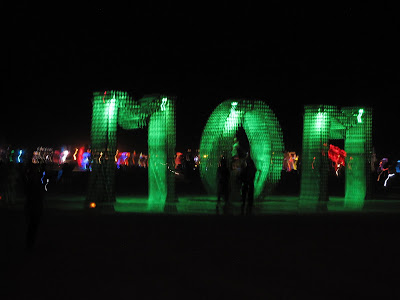
 One person stands inside this spinning cylinder with thousands of led lights.
You can't help smiling when you see the grin on the face of the person inside.
One guy who experienced it asked, "Am I still alive?" Our first glimpse of the Man.
 Two Playa Virgins.
  A panoramic view of the Man.
  The Opulent Temple. This year it's the "temple of forgiveness" with four entrance halls, intricately carved wood, multiple floors and a central altar that opens to the sky.
 A true 3D interactive Rubics Cube, with 4 players.
 We knew we were getting close to our camp when we'd see this sign. Love it. Self-reliance is a big part of it, although the kindness of strangers is amazing out on the playa. People fed me and gave me drinks & good company.
  Uwe and I chillin' at our camp.
Our neighbor was a guy from Wisconsin fluent in German. We met all kinds of interesting people out on the playa. Got painted with friends I met at camp - Jeremy & Taylor.
Daytime wandering around was such a fun adventure. Everyday there was something new to discover. Bronze sculpture in Center Camp.
 Another sculpture in Center Camp.
 Uwe's favorite interactive exhibit. The phantom you see is Uwe jumping to another colored circle. He said he could have done that for hours it was so much fun. Each time you step on a circle, it turns a different color.
 A couch swing. So comfy!
Uwe wearing his burner gear: head lamp, goggles, dust mask. Our camp was directly across from the Barbie Death Camp. Where else can you have a death camp and a wine bistro?
 A mirage in the middle of the desert - a Buddhist Temple.
 Freshly squeezed OJ.
 The Playa at night.
  The Man burning.
A crowd of 40,000 people all sat down in cooperation so that everyone could see the man burn. That blew my mind. Oh the possibilities! Even after the nuclear explosion that nearly melted my face, the man stood for a long time before finally succumbing to the fire.
Lots of preparation goes into Burning Man since you have to be 100% self-reliant - bring all your food, water, shelter, first-aide. We rented and drove this RV through the desert from El Monte RV - a burner friendly RV company - to Black Rock Desert in Nevada.
 Me and my baby. I drove it through the desert, the windy passes, and even up the narrow streets and hills up to my house afterwards and parked it right in front of my house. Something my husband thought would be impossible. So I did the impossible.
 Heading towards the entrance - excitement ramps up as we see other burners & we know we're close after driving for hours through the desert.
 We have arrived. The infamous fence around the perimeter we'd read so much about. Quite a feat considering how large the event is.
 Me driving the RV. A 1st for me & I loved it. So glad we took the scenic route.
 Uwe ringing the Playa Virgin bell & declaring himself a Citizen of Black Rock City.
Greeters at the gate meet individually with each and every person who arrives. Nice personal touch. Anyone whose first time it is at Burning Man is called a Playa Virgin and an initiation is in order.
We heard from other Playa Virgins that they were made to lay in Playa dust and make sand angels on their backs & stomachs. Our greeter was nice & just had us ring a bell and gave us big hugs (although he got so excited to meet virgins that he forgot to give us the printed schedule).
We felt welcome from the start. We found a great spot on the corner to setup camp. Great vantage point to see all the lit up art cars as they drove by.
This was one of my fav's - a house. People were sitting inside drinking tea. Love the idea!
 We rented and drove this RV through the desert from El Monte RV - a burner friendly RV company - to Black Rock Desert in Nevada. Me and my baby. I drove it through the desert, the windy passes, and even up the narrow streets and hills up to my house afterwards and parked it right in front of my house. Something my husband thought would be impossible. So I did the impossible.Heading towards the entrance - excitement ramps up as we see other burners & we know we're close after driving for hours through the desert.We have arrived. The infamous fence around the perimeter we'd read so much about. Quite a feat considering how large the event is.Me driving the RV. A 1st for me & I loved it. So glad we took the scenic route.Uwe ringing the Playa Virgin bell & declaring himself a Citizen of Black Rock City.
Greeters at the gate meet individually with each and every person who arrives. Nice personal touch. Anyone whose first time it is at Burning Man is called a Playa Virgin and an initiation is in order.
We heard from other Playa Virgins that they were made to lay in Playa dust and make sand angels on their backs & stomachs. Our greeter was nice & just had us ring a bell and gave us big hugs (although he got so excited to meet virgins that he forgot to give us the printed schedule).
We felt welcome from the start.
We found a great spot on the corner to setup camp. Great vantage point to see all the lit up art cars as they drove by.This was one of my fav's - a house. People were sitting inside drinking tea. Love the idea!
A lit up fish art car.You could hear the art cars coming before you actually saw them. They were booming with music. I'd run to get my camera in anticipation of the next cool art car to appear before my eyes. Felt like Alice in Wonderland. So much fun!
Thunderdome! Just like the movie Mad Max.Yes, there was a tournament going on inside, but the human bodies swarming all over the outer metal dome was the most fascinating part.
Woman holding fire. Beautiful.The eternal flame they keep going for the burning of the Man on Saturday.Someone loves their mom.
One person stands inside this spinning cylinder with thousands of led lights. You can't help smiling when you see the grin on the face of the person inside.
One guy who experienced it asked, "Am I still alive?"
Our first glimpse of the Man.Two Playa Virgins. A panoramic view of the Man. The Opulent Temple. This year it's the "temple of forgiveness" with four entrance halls, intricately carved wood, multiple floors and a central altar that opens to the sky.It's hard to believe this also goes up in flames. They burn the temple on Sunday.
A true 3D interactive Rubics Cube, with 4 players.We knew we were getting close to our camp when we'd see this sign. Love it. Self-reliance is a big part of it, although the kindness of strangers is amazing out on the playa. People fed me and gave me drinks & good company. Uwe and I chillin' at our camp.Our neighbor was a guy from Wisconsin fluent in German. We met all kinds of interesting people out on the playa.
Got painted with friends I met at camp - Jeremy & Taylor.Daytime wandering around was such a fun adventure. Everyday there was something new to discover.
Bronze sculpture in Center Camp.Another sculpture in Center Camp.Having a chai latte in Center Camp was a little bit of home & felt like such a luxury. This experience makes you realize how much we take for granted in our daily lives.
Uwe's favorite interactive exhibit. The phantom you see is Uwe jumping to another colored circle. He said he could have done that for hours it was so much fun. Each time you step on a circle, it turns a different color.It was fun to watch him be a kid again.
A couch swing. So comfy!Uwe wearing his burner gear: head lamp, goggles, dust mask.
Our camp was directly across from the Barbie Death Camp. Where else can you have a death camp and a wine bistro?A mirage in the middle of the desert - a Buddhist Temple.Couldn't resist taking a photo with my pink, Chinese parasol.
Freshly squeezed OJ.I met this fellow with the same tin camping cup, although his made mine look like a baby cup.
The Playa at night. The Man burning.A crowd of 40,000 people all sat down in cooperation so that everyone could see the man burn. That blew my mind. Oh the possibilities!
Even after the nuclear explosion that nearly melted my face, the man stood for a long time before finally succumbing to the fire.Burning Man was an incredible, life changing experience. It was so much more than I expected. Everyone should experience it at least once in their life.
Sunday, June 21, 2009
President Obama's statement on Iran
"The Iranian government must understand that the world is watching. We mourn each and every innocent life that is lost. We call on the Iranian government to stop all violent and unjust actions against its own people. The universal rights to assembly and free speech must be respected, and the United States stands with all who seek to exercise those rights.
As I said in Cairo, suppressing ideas never succeeds in making them go away. The Iranian people will ultimately judge the actions of their own government. If the Iranian government seeks the respect of the international community, it must respect the dignity of its own people and govern through consent, not coercion.
Martin Luther King once said – “The arc of the moral universe is long, but it bends toward justice.” I believe that. The international community believes that. And right now, we are bearing witness to the Iranian peoples’ belief in that truth, and we will continue to bear witness."
As I said in Cairo, suppressing ideas never succeeds in making them go away. The Iranian people will ultimately judge the actions of their own government. If the Iranian government seeks the respect of the international community, it must respect the dignity of its own people and govern through consent, not coercion.
Martin Luther King once said – “The arc of the moral universe is long, but it bends toward justice.” I believe that. The international community believes that. And right now, we are bearing witness to the Iranian peoples’ belief in that truth, and we will continue to bear witness."
Sunday, May 17, 2009
The Circus is in town!
 Circus Vargas 2009
http://www.circusvargas.org
I haven't been to the Big Top in eons (Cirque du Soleil doesn't count - I'm talking a real circus), so I'm excited about taking my little one to see it today. They have a special interactive pre-show for the kids as well. Tickets are a bit pricey, but it depends on the section seats you purchase.
Saturday, May 16, 2009
Strawberry Festival in Oxnard, CA
 The 26th Annual Strawberry Festival is happening this weekend - May 16 & 17 in Oxnard.
Strawberry Festival Info:
Strawberry Meadows of College Park
3250 South Rose Avenue
Oxnard, CA
1-888-288-9242
http://www.strawberry-fest.org/
 I took my 4 year old daughter today and we had a great time. Kids 4 years old and under are free. Plus all of the rides and shows inside are free.
They do a great job catering to kids with a merry go round, a choo choo train, face painting, shows for kids (magician, clowns, music), and a scarier swinging boat ride for older kids. Bales of hay all around for sitting and enjoying strawberries.
Ticket Prices:
Adult admission = $12
Adult admission = $12
Seniors (62+) = $8
Youths (5-12) = $5
Active military and dependents with ID = $8
Children 4 and under are FREE.
Upside:
Of course the strawberries! Including strawberry: beer, champagne, nachos, a build your own strawberry shortcake, etc.
Downside:
The long lines for everything. Last year they had 60,000 visitors and they're expecting even more this year. So expect long lines especially at the food booths. Some of the booths also sold out.
Tips:
Of course the strawberries! Including strawberry: beer, champagne, nachos, a build your own strawberry shortcake, etc.
Downside:
The long lines for everything. Last year they had 60,000 visitors and they're expecting even more this year. So expect long lines especially at the food booths. Some of the booths also sold out.
Tips:
- Although it was hot in LA, it was fairly chilly in Oxnard with the cloud cover. So bring a thin jacket or sweater.
- Take the 118 fwy. Do NOT take the 101 unless you love sitting in bumper to bumper traffic.
- Park on the outskirts and walk in. I made the mistake of parking in the parking lot. It took an hour to go less than a mile to finally park. Once you get stuck in the Que - it's impossible to get out. Don't make the same mistake!
- The website went down the morning of the festival - I guess too many ppl were accessing it - so make sure you get all the info you need the day before. Or you can call the toll free number I have above for the recorded information message.
Sunday, May 10, 2009
My Mother's Day Gift
 U. got me this original print by @gapingvoid for Mother's Day. How true this statement is! As soon as we get it framed, we're going to hang it up so we can see it everyday.
The key is to find other lone wolves. =)
The Joy of Gardening
Here's my story of a novice gardener's 1st organic vegetable garden.
Living on a hillside, having a garden is difficult without terracing. However there's a small, flat area of land that I had in mind for years. So 6 years after purchasing our home, and with my daughter's 4th birthday fast approaching, I woke up one morning determined to give my 1st garden a try. Beginning Stage:
Beginning Stage: An out of control mound of weeds. Astrid was out there helping me pull weeds. It took a good 2 hours to clear all the weeds.
My mom has a green thumb and I grew up watching her create all sorts of gardens. But I had never tried to grow anything on my own, and more importantly never thought I would be good at it. So now as a mom myself, I felt it important that I at least try especially for Astrid's benefit, to see where food comes from. Vision:
Vision: An organic vegetable garden after a lot of sweat and muscle.
My sweet husband came out with some ice water and asked how we were doing. I told him he could help by pulling some weeds and gathering them up for the green garbage. He mentioned his hay fever and said he was in the house doing laundry and washing the dishes. We both burst out laughing at the irony of the women doing yard work and the man of the house staying indoors cleaning and washing.
If I had my choice, I'd be outdoors in my garden. And I was glad he was there with his camera to take some photos of us. After laying down 2 bags of organic fertilizer and planting the seeds - here is what the garden looked like.
  A month later:
After laying down 2 bags of organic fertilizer and planting the seeds - here is what the garden looked like. A month later:My tranquil, organic vegetable garden. I love it and so does my daughter. I needn't worry about forgetting to water it because my daughter reminds me everyday that we need to water the garden - morning and night.
I wasn't sure if I'd have any luck with seeds, but everything came up eventually. Butter Lettuce.
  Carrots.
  Pumpkin. They're already growing like crazy and I have a feeling they will take over the garden. Hoping for a couple pumpkins in time for Halloween.
 Tomato plants.
  Onions.
  End product:
Butter Lettuce. Carrots. Pumpkin. They're already growing like crazy and I have a feeling they will take over the garden. Hoping for a couple pumpkins in time for Halloween.Tomato plants. Onions. End product: Freshly picked lettuce we made into a salad with organic tomatoes and a vinaigrette. Something very satisfying about eating veggies from your own garden. However, next time I don't think I'll be growing lettuce again. It takes a lot of water and as you can see after all that we had 1 serving of lettuce.
Next I would like to try Brussel sprouts and hardier veggies, now that I'm a bit more confident of my abilities and what my garden will grow.
It feels good to learn something new and try something that I've never tried before. While I'm watering my garden I have some quiet time to meditate each day. I need that tranquility and peace, which my garden gives me. Now I get why my mom was so into gardening. It took me awhile but I finally get it.
Subscribe to:
Posts (Atom)
.JPG)